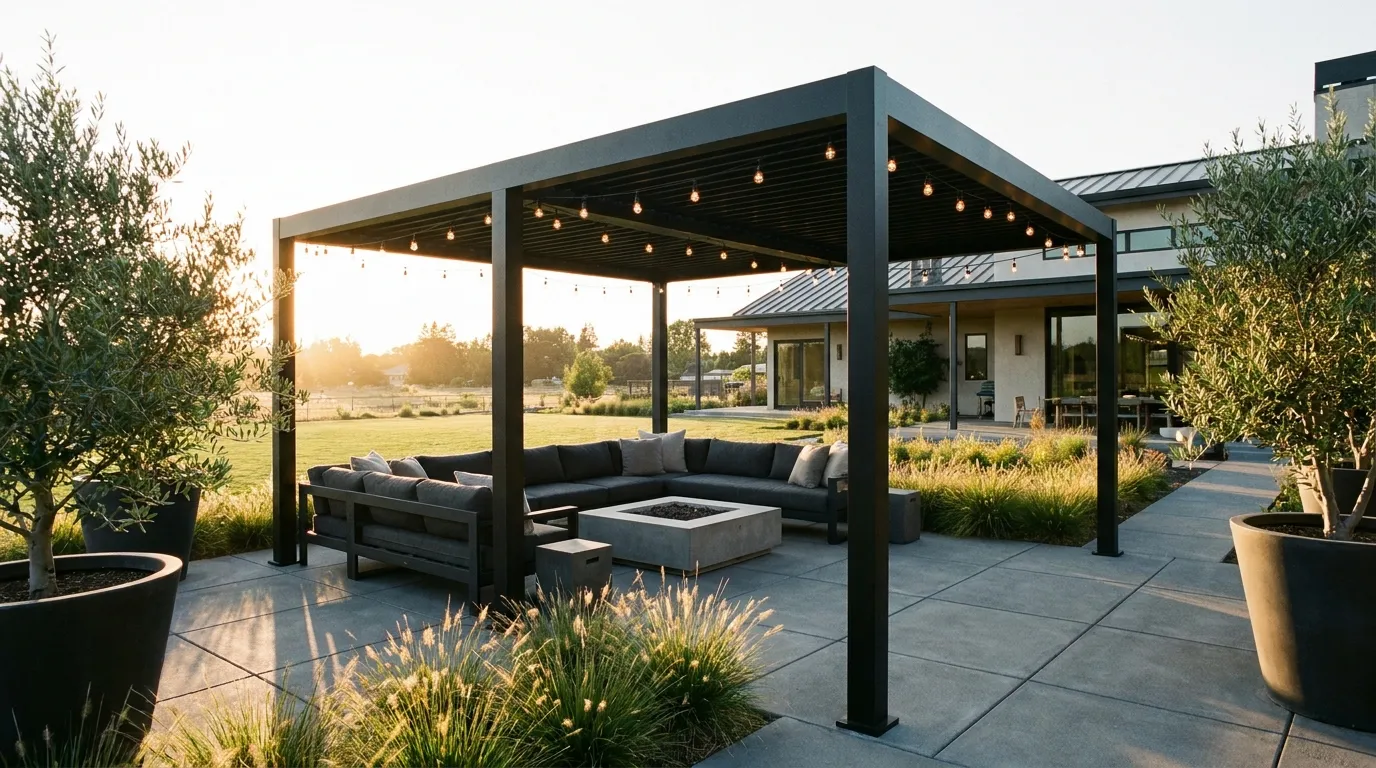
Most backyards have the same problem. There’s a patio, some furniture, and a sun umbrella that topples whenever the wind picks up. The space exists but doesn’t feel planned.
A pergola fixes that. Not because it looks good in photos, but because it defines space. It gives your backyard a structure to organize around — a real reason to be outside more.
This guide covers 25 pergola ideas across every style, size, and budget. Each one is built around how the space actually gets used.
What Is a Pergola?
A pergola is an outdoor structure built from vertical posts supporting horizontal beams and an open or semi-covered roof. It provides partial shade, defines a functional zone, and anchors furniture without enclosing the space.
Pergola vs. Gazebo: A gazebo has a solid roof, is often octagonal, and fully encloses its footprint. A pergola uses open-lattice or louvered beams that filter light rather than block it. Pergolas are generally larger and more adaptable in shape. A gazebo is a destination; a pergola is a room.
Pergola vs. Arbor: Arbors are small, arch-shaped structures used as garden entrances. Pergolas are full overhead structures designed to cover a functional seating or dining area.
Attached Pergola Ideas
An attached pergola connects directly to your home with a ledger board. It needs only two outer posts, making it 10–20% cheaper in materials than a freestanding design. Most municipalities require a building permit for attached structures since they affect your home’s building envelope.
Idea 1: House-Connected Patio Cover
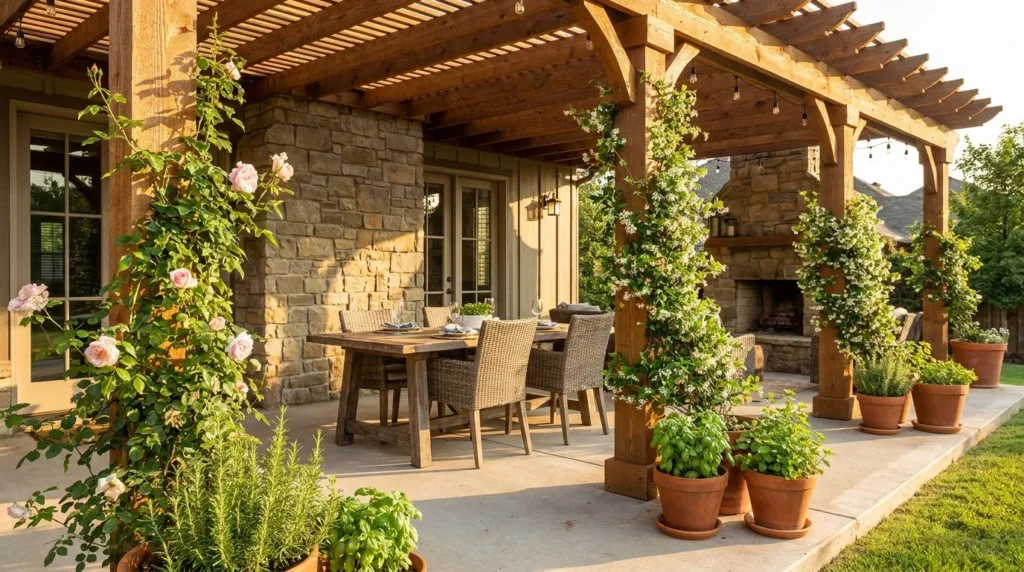
This is the most practical starting point. The pergola extends 10–14 feet out from the back of the house, covering the patio directly outside the door. No separate foundation needed — it ties into the existing concrete slab. Cedar or pressure-treated pine handles moisture exposure here without constant resealing. The structure creates a covered transition between indoors and out, which changes how often you actually step outside.
Idea 2: Door-to-Deck Transition Pergola
A narrow attached pergola — 6–8 feet wide — running along the back wall creates a covered walkway between the door and the main deck area. It feels architectural rather than decorative. Add recessed LED downlights and the corridor works after dark without needing portable lighting.
Idea 3: Attached Pergola With Motorized Louvered Roof
Adjustable aluminum louvers give you precise control over sun and airflow. Open them fully on cool mornings; close them to 80% on hot afternoons. Motorized louvered systems cost $3,000–$8,000 for the roof component alone, but they permanently replace retractable awnings, umbrellas, and shade sails in one structure.
Idea 4: Attached Side-Yard Pergola
Side yards usually become utility corridors by default. A 6×16-foot attached pergola turns that strip into a working outdoor kitchen zone. A grill station, prep shelving, and pendant lighting all fit cleanly under the structure. The narrow footprint works in your favor — it creates a focused, purposeful area rather than wasted space.
Freestanding Pergola Ideas
Freestanding pergolas stand on four or more independent posts with no connection to the house. They go anywhere — next to a pool, in the center of a lawn, beside a fire pit. They cost $500–$1,500 more than attached designs in materials and footings, but placement is completely unrestricted.
Idea 5: Garden Focal-Point Pergola
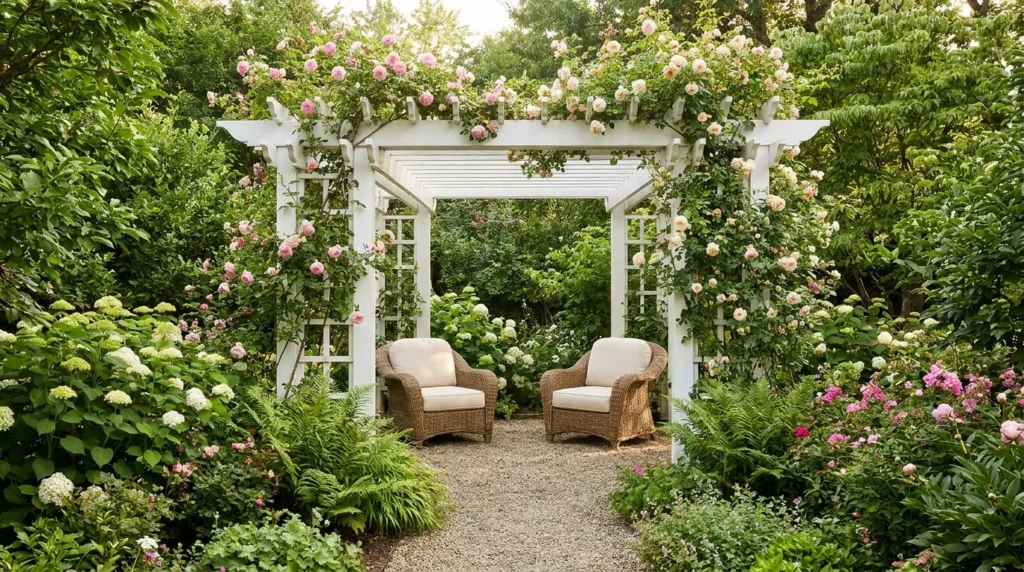
A freestanding pergola placed 15–20 feet from the house becomes a destination in the yard rather than an extension of the house. It gives the backyard a second anchor point that organizes the rest — lawn, garden beds, and pathways — around it. A seating area with 4–6 chairs and a coffee table fits comfortably under a 10×12-foot structure. Add climbing roses or wisteria on the posts and it becomes a year-round garden feature.
Idea 6: Poolside Freestanding Pergola
One fixed pergola replaces three scattered umbrellas. Position it to cover a lounge section beside the pool — 12×14 feet handles two chaises and a drinks table. Aluminum or vinyl outperforms wood here; constant humidity and chlorine exposure accelerate cedar deterioration faster than most homeowners expect. For a complete approach to the pool area, our guide to swimming pool landscaping ideas covers the full layout and plant strategy around the water.
Idea 7: Fire Pit Pergola
A pergola over a fire pit works when the structure has at least 10 feet of clearance between the fire surface and the roof beams, and the overhead uses open-lattice rather than solid panels. The pergola frames the gathering space without enclosing it, gives you a place to run string lights, and keeps the area from feeling exposed and unplanned. Before you finalize placement and clearance dimensions, our fire pit safety and design guide covers the key rules for safe pergola-adjacent fire installations.
Idea 8: Freestanding Pergola on Gravel Base
Skip the concrete slab. Compacted gravel is a legitimate base option for lighter freestanding pergolas when the posts are anchored with concrete footings driven below the frost line. Gravel drains better than solid concrete, stays cooler underfoot in summer, and costs significantly less per square foot to install.
Modern Pergola Ideas
Modern pergolas are defined by restraint. Thick squared-off posts. Flat-profile louvers that sit flush. Color palettes of matte black, dark bronze, or white. The design avoids competing with the landscape.
Idea 9: Black Aluminum Frame With Concrete Pavers
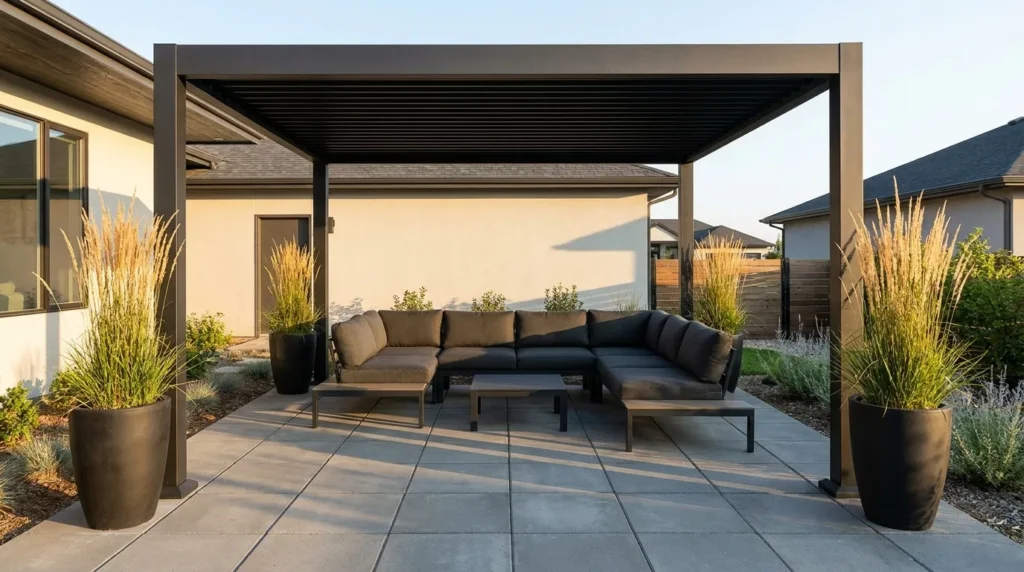
This is the most requested modern pergola in 2026. The black powder-coated finish reads as intentional against nearly any surface — concrete, stone, lawn, or gravel. Pair it with a charcoal outdoor sectional, matte black pendant lights, and 24×24-inch pavers. Tall ornamental grasses at the base corners prevent the setup from looking too rigid.
Idea 10: Flat-Roof Louvered Pergola With Glass Inserts
Glass or polycarbonate inserts in a flat-roof frame let you stay outside in light rain while keeping the space fully lit. Polycarbonate panels cost $8–$15 per square foot installed — the affordable option. Tempered glass is heavier and more expensive, but handles high wind loads significantly better and looks sharper from the inside.
Idea 11: Minimalist Steel Frame Pergola
Steel spans wider distances without intermediate posts. A 16×20-foot open structure with no center post is achievable in steel. It isn’t realistic in cedar without unusually deep beam sections. The aesthetic suits contemporary homes with flat rooflines and angular architecture. Budget for galvanized or powder-coated finishes up front — untreated steel starts rusting in the first wet season.
Wood Pergola Ideas
Wood has warmth that aluminum never replicates. The three practical choices for most homeowners:
- Cedar: Naturally rot-resistant. Lasts 15–25 years with staining every 3–5 years. Costs $15–$35 per linear foot.
- Redwood: More durable than cedar, better in wet climates, more expensive. Costs $25–$50 per linear foot.
- Pressure-treated pine: The most affordable option. Needs annual sealing to prevent splitting. Costs $8–$20 per linear foot.
Idea 12: Dark-Stained Timber With String Lights
A cedar or pine pergola stained in deep walnut or espresso reads more formal in the yard. The darker tone looks grounded and architectural rather than rustic. Warm white string lights at 2700K across the beams are the single most effective detail in a wood pergola. Run the wiring properly — outdoor-rated cable, weatherproof outlets — rather than running extension cords across the yard. For a full breakdown of what works, our guide to cozy outdoor lighting ideas covers fixture types, wiring costs, and placement logic before you start cutting into beams.
Idea 13: Cedar Pergola With Climbing Vines
Wisteria, climbing roses, or Virginia creeper trained along the posts and beams turns the pergola into a garden feature. Allow 2–3 growing seasons for meaningful coverage. Wire trellis systems on the posts ($50–$200) guide growth cleanly and prevent stems from damaging the wood. If you want to extend this approach, our vertical garden walls and patio planting guide covers how to build out vertical greenery around the full perimeter.
Idea 14: Reclaimed Wood Pergola
Reclaimed barn beams and old-growth pine carry texture and character that new lumber doesn’t have. The look suits farmhouse and cottage-style backyards naturally. Dry and treat old barn wood before installing — it often carries residual moisture that causes warping if sealed too quickly.
Small Backyard Pergola Ideas
A compact, well-placed pergola often has more visual impact in a small space than a large structure in a sprawling yard. The key is purpose: size it for the furniture, not the available space.
| Size | Best Use |
|---|---|
| 8×8 ft | Reading nook, 2-person seating, corner garden feature |
| 8×10 ft | 4-person dining, narrow patio alongside a house wall |
| 10×10 ft | 4–6 person dining set with comfortable clearance |
| 10×12 ft | Lounge sectional or dining table with chairs |
Idea 15: 8×10 Patio Pergola for 4-Person Dining
An 8×10 fits a standard 4-person outdoor dining set with 18–24 inches of clearance on each side. Position it flush against the house wall to preserve slab space for circulation. Keep the overhead open-lattice — a covered roof in a small space makes it feel like a box. For more on furniture layout and zone planning in compact spaces, our small patio design inspiration guide covers the key decisions in detail.
Idea 16: Corner Pergola for Urban Yards
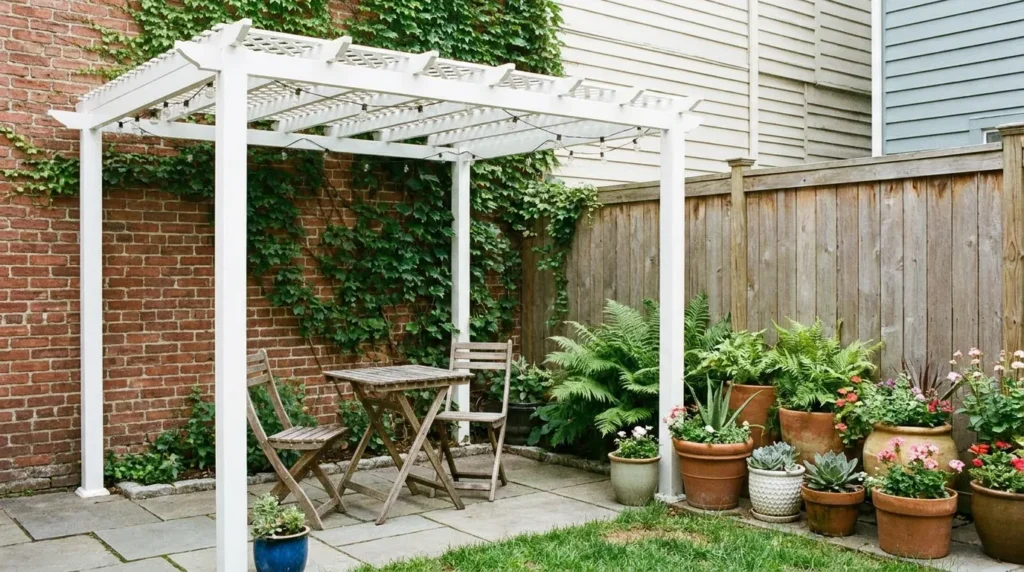
A pergola set into a backyard corner uses two existing boundary walls as built-in enclosure. You only need two posts on the open sides. The placement creates natural privacy without adding curtains or screens, and the reduced post count keeps costs lower than a center-of-lawn freestanding setup.
Idea 17: Swing Pergola for Small Gardens
A compact structure built around one suspended bench swing is one of the most-used setups in small backyards. Casual, functional, and low footprint — a 6×8-foot frame is enough. Pressure-treated pine on a budget, or a prefab kit for $400–$900. It gets daily use in ways that larger, more formal pergolas often don’t.
Pergola Ideas by Use Case
Idea 18: Outdoor Kitchen Pergola
An outdoor kitchen under a pergola needs at least 9 feet of clearance above the cooking surface. Open-lattice or louvered roofs handle smoke better than solid panels — don’t install a covered roof directly over a grill without ventilation planning. Overhead lighting above the prep area is non-negotiable for evening cooking. Choosing the right materials for the kitchen structure itself is as important as the pergola design — our outdoor kitchen materials guide covers what stands up to heat, humidity, and grease long-term.
Idea 19: Hot Tub Pergola
A pergola over a hot tub adds privacy, gives you a lighting plane, and defines the spa zone as a distinct destination. Use aluminum or vinyl — moisture resistance takes priority over aesthetics here. Build with at least 4 feet of clearance around all sides of the tub. Add outdoor curtains on two sides for wind and privacy. For a comprehensive look at privacy options that work alongside pergola structures, our backyard privacy solutions guide covers screens, plants, and panel systems in detail.
Idea 20: Poolside Lounge Pergola
A 12×16-foot poolside pergola covers a dedicated lounge zone with two chaises, a side table, and a drinks station. Aluminum or vinyl — never wood in a chlorine-heavy environment without serious sealing work. Position the structure to catch natural afternoon shade, or the louvers become the only sun control and that gets old fast.
Idea 21: Pergola With Outdoor Fireplace
Centering a pergola around a gas or wood-burning fireplace creates a year-round gathering point that actually gets used in shoulder seasons. The structure frames the fireplace, organizes the seating arrangement around it, and gives you an overhead plane for lighting. Keep the roof open-lattice — spark clearance and smoke ventilation both matter.
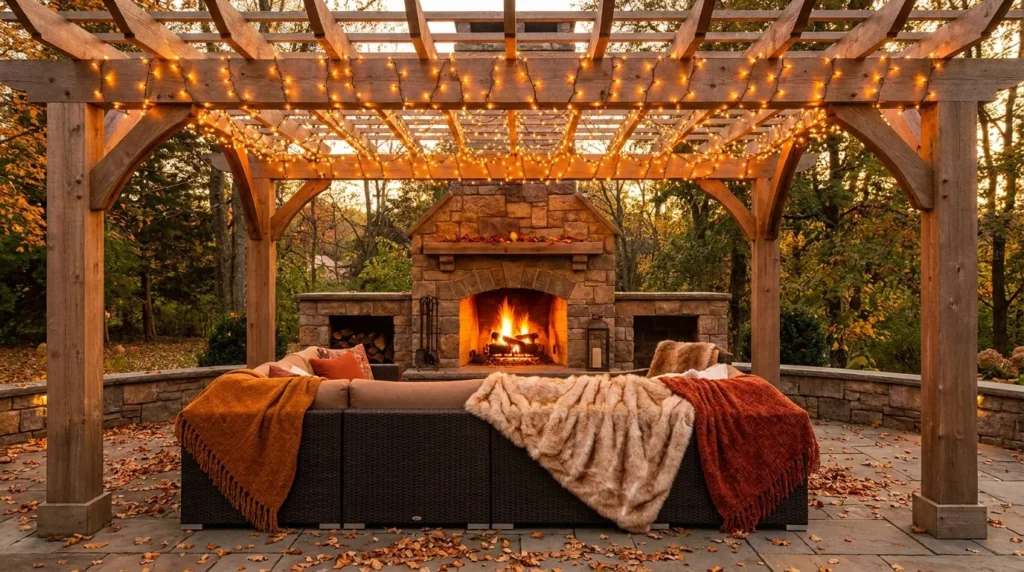
Idea 22: Dining Pergola With Statement Lighting
A dedicated dining pergola needs lighting designed from the start, not added after the fact. A single outdoor chandelier or 3–5 pendants centered over the table does more than 30 feet of string lights spread across the overhead. Run a proper outdoor electrical line — $200–$800 installed — rather than relying on extension cords. The furniture underneath matters as much as the structure. Our guide to outdoor furniture trends covers what’s performing well in 2026 specifically for pergola dining setups.
Pergola Lighting Ideas
Idea 23: String Light Grid
Run 3–4 parallel lines of warm-white string lights across the overhead beams, spaced 12–18 inches apart. Use 2700K bulbs. Secure lines with outdoor-rated cup hooks, not staples or tape. Each 25-foot string costs $30–$80; a standard 10×12 pergola needs 2–4 runs. This is the cheapest effective lighting setup and the most forgiving to install.
Idea 24: Recessed LED Downlights
Aluminum pergolas can be built with channel tracks in the beams for recessed LED strips or spotlights. They disappear during the day and illuminate cleanly at night. Add dimmer control — flat bright light at full power is too harsh for outdoor dining and kills the atmosphere.
Idea 25: Hanging Lantern Mix
For wood pergolas, pendant lanterns hung at varied drop lengths create a layered lighting effect. Mix drops between 12 and 30 inches. Use outdoor-rated pendants with Edison-style bulbs ($15–$40 each). Three pendants in a line over the dining area make more visual impact than a uniform grid of string lights, and the effect photographs well for any homeowner wanting to show off the space.
Pergola Materials Compared (2026)
| Material | Installed Cost / Sq Ft | Lifespan | Maintenance | Best For |
|---|---|---|---|---|
| Cedar | $15–$35 | 15–25 yrs | Stain every 3–5 yrs | Classic warm styles, most climates |
| Redwood | $25–$50 | 20–30 yrs | Occasional sealing | Wet climates, premium builds |
| Pressure-Treated Pine | $8–$20 | 10–15 yrs | Annual sealing | Budget builds, DIY kits |
| Aluminum | $20–$40 | 30+ yrs | Minimal | Modern style, poolside, humid areas |
| Vinyl | $10–$30 | 20–30 yrs | Wipe down only | High UV exposure regions |
| Fiberglass | $50–$60 | 30+ yrs | Minimal | Extreme temperature swing regions |
Pergola Costs in 2026 — What to Budget
Most homeowners spend $2,500–$12,000 for a professionally installed pergola. Here’s how the numbers break down.
DIY kit ($1,000–$3,000): Prefab cedar or aluminum kits include pre-cut components. A 10×10 cedar kit runs $700–$1,500 before delivery. Add $300–$600 for footings and hardware. Expect 1–2 weekends of work.
Standard professional install ($2,000–$6,000): Covers a basic freestanding or attached pergola in cedar or pressure-treated pine. Labor adds $500–$1,500 for a straightforward install. Permits for attached structures run $200–$500 depending on jurisdiction.
Custom or premium build ($8,000–$15,000+): Large footprints, motorized louvers, integrated LED systems, and specialty materials push into this range. Motorized louver roofs alone run $3,000–$8,000.
Common add-on costs:
- Retractable canopy: $300–$1,500 (manual) or $1,000–$4,000 (motorized)
- Wired string lighting or pendants: $200–$800 installed
- Outdoor privacy curtains: $200–$600
- Ceiling fan with electrical run: $300–$800
- Climbing plant wire trellis: $50–$200
Before calling contractors, use our patio cost estimator to build a baseline budget range. If the pergola is part of a larger backyard renovation, the home renovation budget planner helps you allocate across multiple scopes without losing control of the total spend.
If your overall budget is under $1,000, our affordable backyard makeover guide covers lower-cost ways to define outdoor zones before committing to a permanent structure.
Do You Need a Permit for a Pergola?
Attached pergolas: Almost always require a permit. They tie into your home’s structure, modify the building envelope, and must pass structural load review. Budget $200–$500 for permit and inspection fees.
Freestanding pergolas: Often exempt if under 120–200 square feet, depending on jurisdiction. A 10×10 pergola at 100 square feet is typically permit-free in most U.S. municipalities. A 12×16 at 192 square feet may cross the threshold in some areas.
Check with your local building department before starting. Rules vary significantly between cities and counties. In HOA communities, you may also need written association approval regardless of municipal permit requirements.
How to Choose the Right Pergola for Your Space
Step 1 — Define the purpose. Dining, lounging, cooking, poolside? Each use case drives different size and material decisions. Don’t buy a structure and then figure out what it’s for.
Step 2 — Attached or freestanding? Attached is cheaper if your layout allows it. Freestanding goes anywhere but costs more in materials and footings.
Step 3 — Match material to your climate. Wood works in most regions with consistent maintenance. In humid areas or near water, aluminum and vinyl outperform wood long-term. In freeze-thaw climates, fiberglass handles temperature cycles better than vinyl.
Step 4 — Size for the furniture, not the space. Use the sizing table from the small backyard section. For dining, add 24 inches of clearance around the table on every side. For lounging, allow 36 inches between furniture edges and posts.
Step 5 — Plan the electrical first. Adding wiring after the pergola is built means drilling through finished beams. Rough in conduit during framing.
For more detailed design inspiration as you finalize your plan, our pergola design ideas guide covers layouts, style combinations, and finishing details across a wide range of backyard configurations.
Common Pergola Planning Mistakes
1. Sizing too small. An 8×8 pergola over a 6-person dining set is cramped and frustrating. Size for the furniture first. Add clearance second.
2. Wrong material for the climate. Cedar in a high-humidity coastal yard deteriorates fast without consistent maintenance. Match the material to your actual conditions.
3. Skipping the permit check. An unpermitted attached structure creates complications at sale and during insurance claims. Pull the permit.
4. No electrical plan. Wiring added after construction means drilling through finished beams. Plan the conduit route during the build.
5. Bad placement. A pergola placed where afternoon sun still hits the seating area defeats the purpose. Observe where sun falls between 2–4 PM before setting posts.
Frequently Asked Questions
How long does a cedar pergola last? 15–25 years with regular maintenance. Stain or seal every 3–5 years and replace any split or deteriorating boards as they appear.
Can I build a pergola myself? Yes, with a prefab kit. Most homeowners complete an 8×10 or 10×10 kit in one to two weekends using basic tools. Custom builds with concrete footings typically require a licensed contractor.
What’s the difference between a pergola and a gazebo? A pergola has an open or semi-covered roof that filters light. A gazebo has a solid roof and is partially enclosed on the sides. Pergolas are generally larger, less expensive, and more adaptable.
Do pergolas add home value? Quality outdoor living structures typically recover 50–80% of their cost in perceived home value, based on NAR and Houzz buyer preference data. A well-built, properly permitted pergola contributes positively to property appeal.
How far does a pergola need to be from the property line? Most residential zones require 5–10 feet of setback from property lines for accessory structures. Rules vary by municipality. Always verify local codes before finalizing placement.
Can a pergola be made rain-proof? Yes. Polycarbonate panels, tempered glass, motorized louvers, and solid wood or composite roofs all provide rain protection. Motorized louvered systems are the most flexible — they open for sun, close for rain.
Final Thoughts
A pergola does one thing better than any other backyard structure: it defines space without enclosing it. That’s what makes a backyard feel finished — not more plants, not better furniture, but overhead structure that gives the space a reason to exist.
Pick the right size for how you actually use the space. Match the material to your climate. Plan the lighting and electrical before the footings go in. The 25 ideas above cover every realistic scenario — from a compact 6×8 swing pergola to a motorized aluminum louver system over a pool deck. Start with purpose. Style decisions follow naturally from there.

Leave a Reply