The KonMari Method is a decluttering system created by Japanese organizing consultant Marie Kondo. It works by organizing your home by category — not room by room — and keeping only items that “spark joy.” You follow five categories in a fixed order and complete the whole process in one committed effort, not gradually over months of halfhearted tidying sessions.
What Is the KonMari Method?
Marie Kondo published The Life-Changing Magic of Tidying Up in Japan in 2011. The English edition arrived in the US in 2014 and hit #1 on the New York Times bestseller list, eventually selling over 11 million copies worldwide. Her Netflix show Tidying Up with Marie Kondo debuted in 2019 and introduced the method to an even wider audience.
The name comes directly from her own: KONdo + MARi = KonMari.
The method’s core argument is simple. Clutter returns because people organize without first discarding. Most tidying attempts rearrange what you own without questioning whether you need any of it. KonMari reverses that sequence — discard first, organize second.
What makes it genuinely different from room-by-room cleaning is the category rule. You gather every single item of one type from your entire home — every piece of clothing, from every drawer, closet, and laundry bag — before touching a single one. That total visibility changes how you decide.
Marie Kondo calls the decluttering process a “tidying festival” — a single, focused effort rather than slow, piecemeal attempts. The goal is to finish completely, once, so you never need to repeat it.
The original Japanese word behind “spark joy” is tokimeku — a verb describing a physical flutter of excitement. It’s a body-level response, not a mental checklist.
The 6 Official Rules of the KonMari Method
Most articles cover the 5 categories and skip this entirely. But these 6 rules are the actual foundation of the method — the categories only work inside this structure.
- Commit yourself to tidying up. Decide you’re doing this fully, not casually.
- Imagine your ideal lifestyle. Before touching anything, picture exactly how you want your home to feel when it’s done. Be specific.
- Finish discarding first. Don’t organize a single item until the complete discard process is done.
- Tidy by category, not by location. Gathering all items of one type from across the house isn’t optional — it’s the mechanism that makes the whole process work.
- Follow the correct category order. The sequence builds your decision-making skill progressively, from easiest to hardest.
- Ask yourself if each item sparks joy. This is the filter for every decision.
The 5 KonMari Categories (in Exact Order)
The order matters. Marie Kondo arrived at this sequence after working with hundreds of clients. Starting with the easiest decisions and ending with the hardest means your joy-sensing ability is strongest exactly when you need it most.
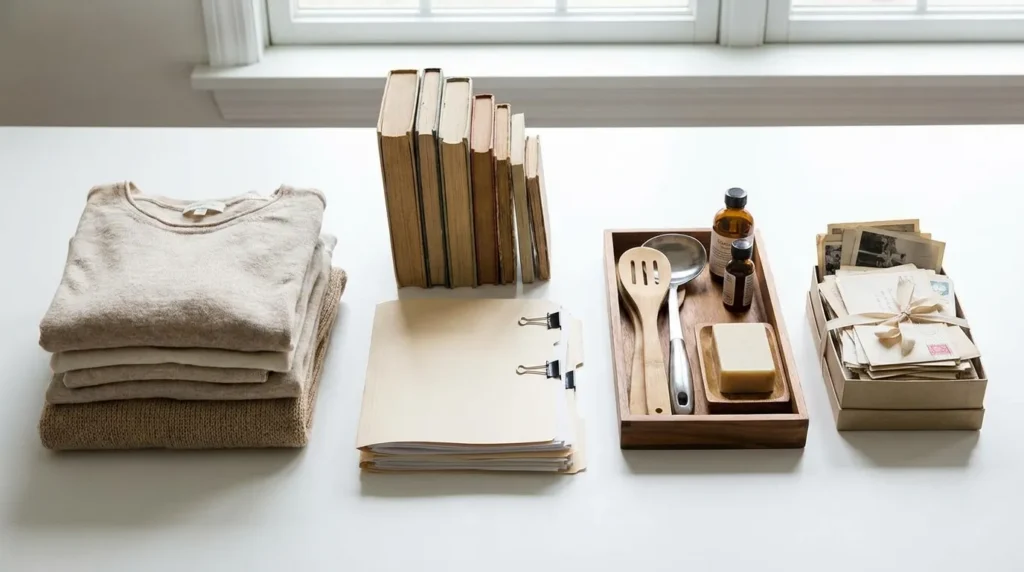
Clothes
Pull every piece of clothing from every room in your home — hall closets, under the bed, storage bags, the laundry basket, that chair in the corner. Put it all in one pile.
Most people are surprised by what they see. The pile makes decisions easier, not harder. It’s difficult to justify 12 nearly identical black t-shirts when they’re all in front of you at the same time.
Pick up each piece individually. Ask whether it sparks joy. If yes, keep it. If not, thank it and set it in the discard pile.
Once you’ve finished sorting, the way you store clothes makes a difference in how long your results last. A capsule wardrobe approach pairs naturally with KonMari — fewer pieces, all of them genuinely loved.
Books
Take every book off every shelf and pile them on the floor. Pick each one up — not to open it, just to hold it — and ask if it sparks joy.
Books you haven’t opened in years often feel like obligation rather than joy. The physical test cuts through the mental justifications quickly. Trust it.
Papers
Marie Kondo’s position on papers is direct: discard almost all of it. The default assumption is that papers go unless there’s a clear reason to keep them.
Keep: Tax documents (7 years), active insurance policies, legal documents, warranties for items you currently own, current medical records.
Discard: Old utility bills, expired warranties, outdated manuals, credit card offers, most receipts older than one year.
After this category, setting up a lean filing system keeps everything accessible without accumulation. If you’re also working on your workspace, a solid home office organization system makes maintaining the papers category much easier long-term.
Komono (Miscellaneous)
This is the largest category. It covers kitchen items, bathroom products, electronics, cables, tools, hobby supplies, cleaning products, and decorative objects.
Work through one sub-group at a time — kitchen utensils, then bathroom products, then electronics. Don’t mix sub-groups. That separation is what keeps the decision-making manageable rather than overwhelming.
Sentimental Items
Save this for last. Always.
By the time you reach photos, letters, gifts, and childhood keepsakes, you will have picked up and evaluated thousands of objects. Your ability to sense joy versus guilt versus obligation will be sharper than it was on day one.
Sentimental items carry real emotional weight. Many people underestimate how draining this stage is. If you want focused guidance just for this category, the detailed guide on decluttering sentimental items covers the emotional side of the process in depth.
How to Know If Something Sparks Joy
Hold the item with both hands. Pay attention to your body’s response, not the argument running in your head.
Marie Kondo describes joy as “a little thrill, as if the cells in your body are slowly rising.” The Japanese word tokimeku captures that — a physical flutter, not a reasoned conclusion.
To calibrate: Hold something you genuinely love first. Notice exactly how that feels. Then hold something you’ve been keeping out of guilt. The difference is usually immediate.
When you feel genuinely unsure: The hesitation is your answer. Items that actually spark joy don’t make you pause.
The most common mistake here is overthinking. The method only works if you trust the physical response over the mental arguments.
The KonMari Folding Method
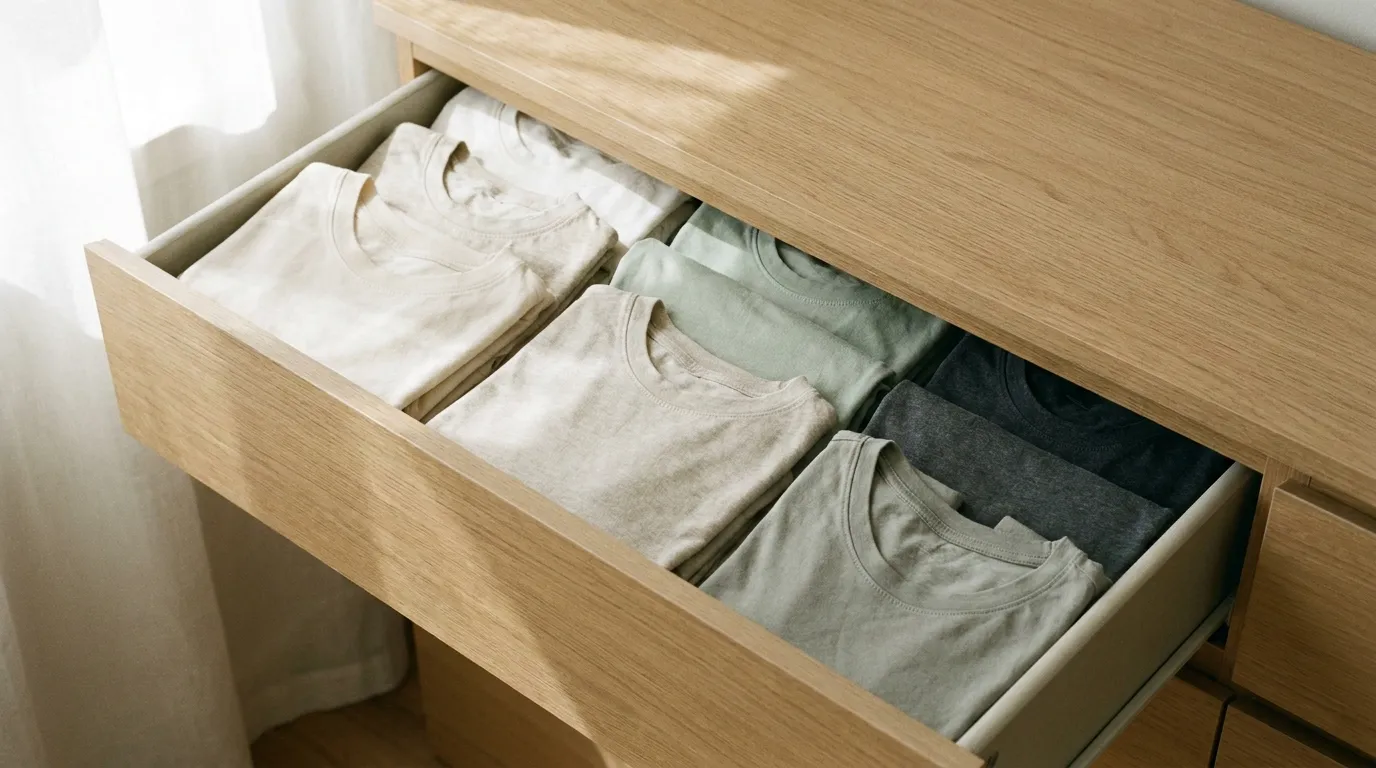
KonMari folding means clothes stand upright in drawers instead of being stacked in horizontal layers. Two problems solved: you can see every item at once, and pulling one piece doesn’t collapse everything else.
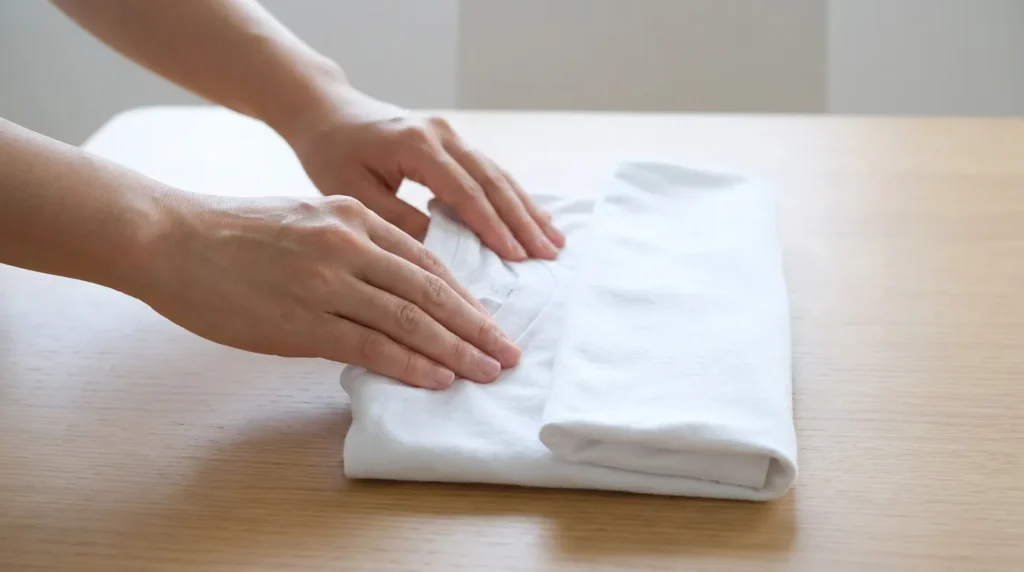
For t-shirts:
- Lay flat, face down
- Fold one side to the center; fold the sleeve back
- Repeat on the other side — you now have a long rectangle
- Fold the bottom third up, then the top third down
- Stand it upright in the drawer
For pants:
- Fold lengthwise along the crease
- Fold the hem up to the waistband
- Fold in half or thirds until it stands upright on its own
For socks: Lay flat, fold in half, then in thirds. Don’t ball them. Kondo argues the balling technique keeps elastic in constant tension and wears it out faster.
Drawer dividers make this system significantly easier to maintain. Without them, the upright rows slowly collapse. The best drawer organizers for maximizing space work well for this specific setup. For closet shelves and hanging areas beyond drawers, these closet organization ideas for small spaces apply KonMari’s vertical storage principles throughout.
How Long Does KonMari Take?
Marie Kondo estimates the tidying festival takes about 6 months for most homes. In practice, most people complete it across 3 to 6 months of weekend sessions, each running 3–4 hours.
The “all at once” instruction doesn’t mean one weekend. It means you don’t do a little here and a little there, indefinitely, with no defined endpoint. You commit to completing the full process before considering yourself done.
Clothes are usually finished in one or two sessions. Books and papers go quickly for most people. Komono — the miscellaneous category — takes the most time and typically spans several sessions over multiple weeks. Sentimental items can take a full day or more on their own.
Rushing through decisions leads to regret and re-cluttering. Taking proper time with each item produces choices that hold.
Is the KonMari Method Right for You?
Works well if you:
- Are ready to commit fully, not casually
- Have deep emotional attachment to belongings and want a framework for working through it
- Want a one-time deep process rather than an ongoing decluttering routine
- Live alone or with a partner who’s genuinely on board
- Have several months of weekend availability
Harder to apply if you:
- Need a gradual approach due to limited time, energy, or physical ability
- Share a home with people who are unwilling to participate
- Are mid-move or mid-renovation
- Prefer flexibility and dislike fixed methods
KonMari is not the same as minimalism. Minimalism is about owning as little as possible. KonMari is about owning what brings you joy — which could be a substantial amount of things. The two methods sometimes produce similar-looking outcomes but they start from different questions.
If you’re drawn to a leaner, structure-first approach instead, the minimalist home organization checklist covers that framework as an alternative starting point.
Common KonMari Mistakes
Starting with sentimental items. This almost always causes people to quit. Sentimental items require your sharpest decision-making. Work up to them through the earlier categories first.
Tidying room by room instead of by category. This rearranges what you own without ever showing you the full picture. You’ll be back where you started within a year.
Keeping things “just in case.” Marie Kondo’s position: if you haven’t used something, it already served its purpose by teaching you that you don’t need it. The just-in-case mindset is what fills most cluttered homes in the first place.
Treating it as a gradual project. Slow, indefinite tidying produces slow, indefinite results. The tidying festival philosophy — committing to a complete process — is what makes the outcome permanent.
Buying storage before finishing the discard phase. You have no idea how much storage you actually need until the discard phase is done. Buying bins and organizers first wastes money and gives you more places to hide things rather than remove them.
What Happens After You Finish?
Maintenance after KonMari is genuinely simple. Most people report that once every item has a designated place, keeping the home tidy becomes automatic rather than effortful.
The daily habit is one rule: return everything to its designated spot after using it. That’s the entire maintenance system.
The larger shift is what happens to your buying behavior. After going through the full process, most people become significantly more selective about what they bring home. The joy test carries into shopping — you start asking the question before purchasing, not after you’ve already filled another drawer.
Some people report bigger changes: switching careers, choosing to downsize voluntarily, approaching relationships differently. These aren’t guaranteed outcomes, but they’re consistent enough across accounts that Marie Kondo addresses them directly in her books.
For building a reliable system that keeps your home organized long after the festival ends, a time-saving organization system helps make the daily habits stick. You can also use the cleaning schedule generator to build a maintenance routine tailored to your home’s actual size and needs.
How to Start Today
You don’t need to read the book first, buy any products, or clear an entire week from your calendar.
- Pick a day. Block 3–4 hours. This weekend works.
- Pull every piece of clothing from every room in your home. Every drawer, closet, bag, and basket. Pile it all on the bed.
- Pick up each piece individually. Ask: does this spark joy? Yes means keep it. No means thank it and add it to the donate pile.
That’s it. Everything else in the method follows from finishing this one category completely.
Conclusion
The KonMari Method isn’t about owning as little as possible. It’s about being deliberate — keeping what genuinely adds to your life and letting go of what doesn’t.
It works because it addresses the actual reason clutter builds up: people organize without discarding, and they keep things out of guilt rather than joy. The method forces a simpler, more honest question for every object you own.
Start with clothes. Hold each piece. Trust the response you feel before the argument starts in your head.
Most people who complete the full process never need to do it again. That’s the point of doing it properly once.


Leave a Reply