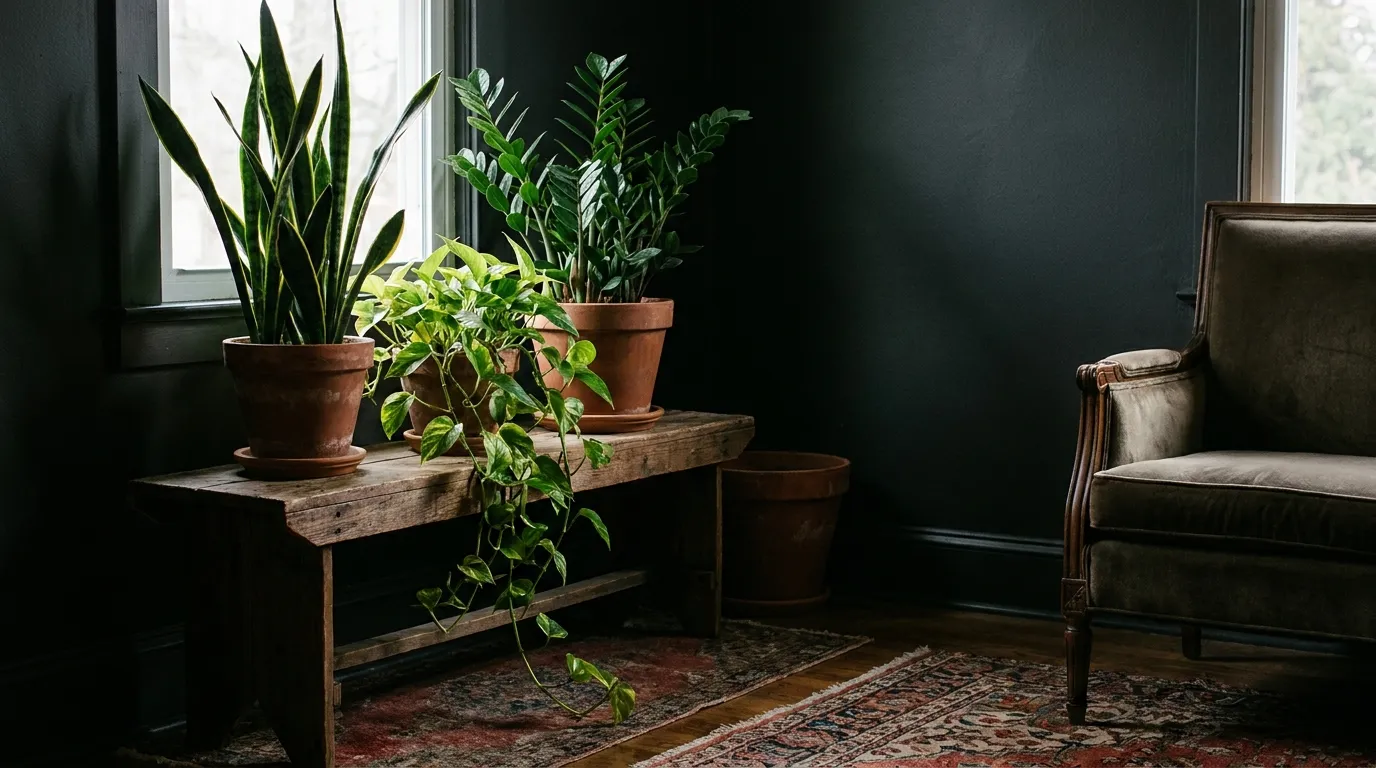
Most articles about low-light houseplants are lying to you.
They list plants that technically survive in low light — then watch you fail with them in your actual dim hallway or north-facing bedroom. The plants looked fine in the brightly lit garden center. At home, they stretch, yellow, and slowly give up.
The problem isn’t your care routine. It’s the plant selection.
This guide covers 25 plants that genuinely handle low-light conditions — not plants that merely tolerate a brief stay in dim conditions before quietly dying. Each entry includes honest care details, a failure condition, and pet safety information. No filler. No false promises.
What “Low Light” Actually Means (And What It Doesn’t)
Low light has a specific measurement: 50 to 250 foot-candles. One foot-candle equals one lumen per square foot — a standard unit of light intensity used in horticulture. A bright, sunny windowsill can hit 5,000 foot-candles. A north-facing room in winter sits around 50 to 100.
The reading test: If you can read a book comfortably in your space during the day without switching on a lamp, you have enough light for low-light plants. If you need artificial light to read, you’re in no-light territory — and you’ll need a grow light.
Low light does not mean no light. Every plant on this list requires some photosynthesis. Windowless rooms, deep basements, and interior offices with no windows are not low-light environments — they’re dark environments. That distinction matters. Scroll to the grow light section before buying plants for truly windowless spaces.
For a deeper look at sunlight requirements across popular houseplants, including how to measure light levels at home, that guide covers the full picture.
The 25 Best Low-Light Indoor Plants
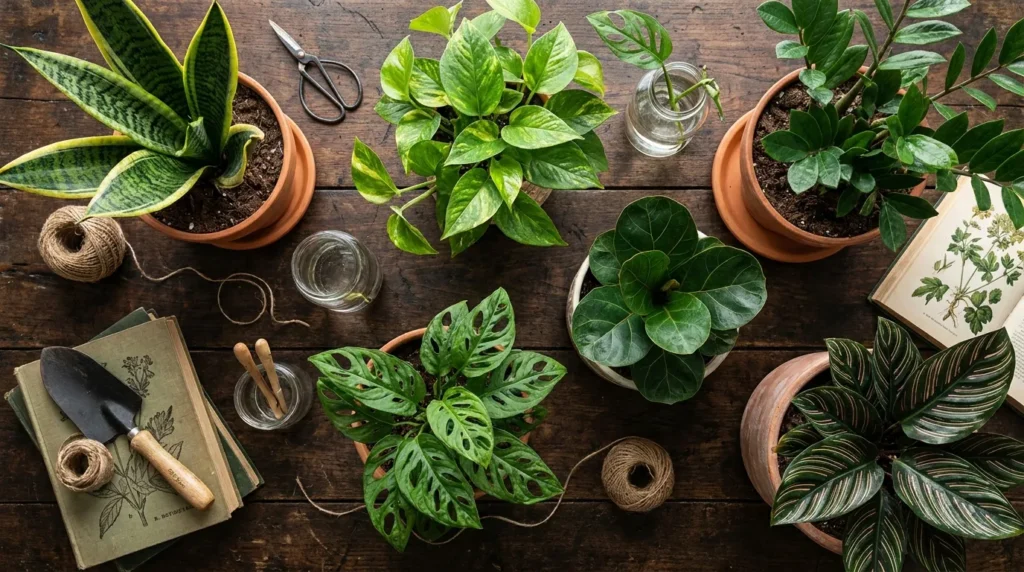
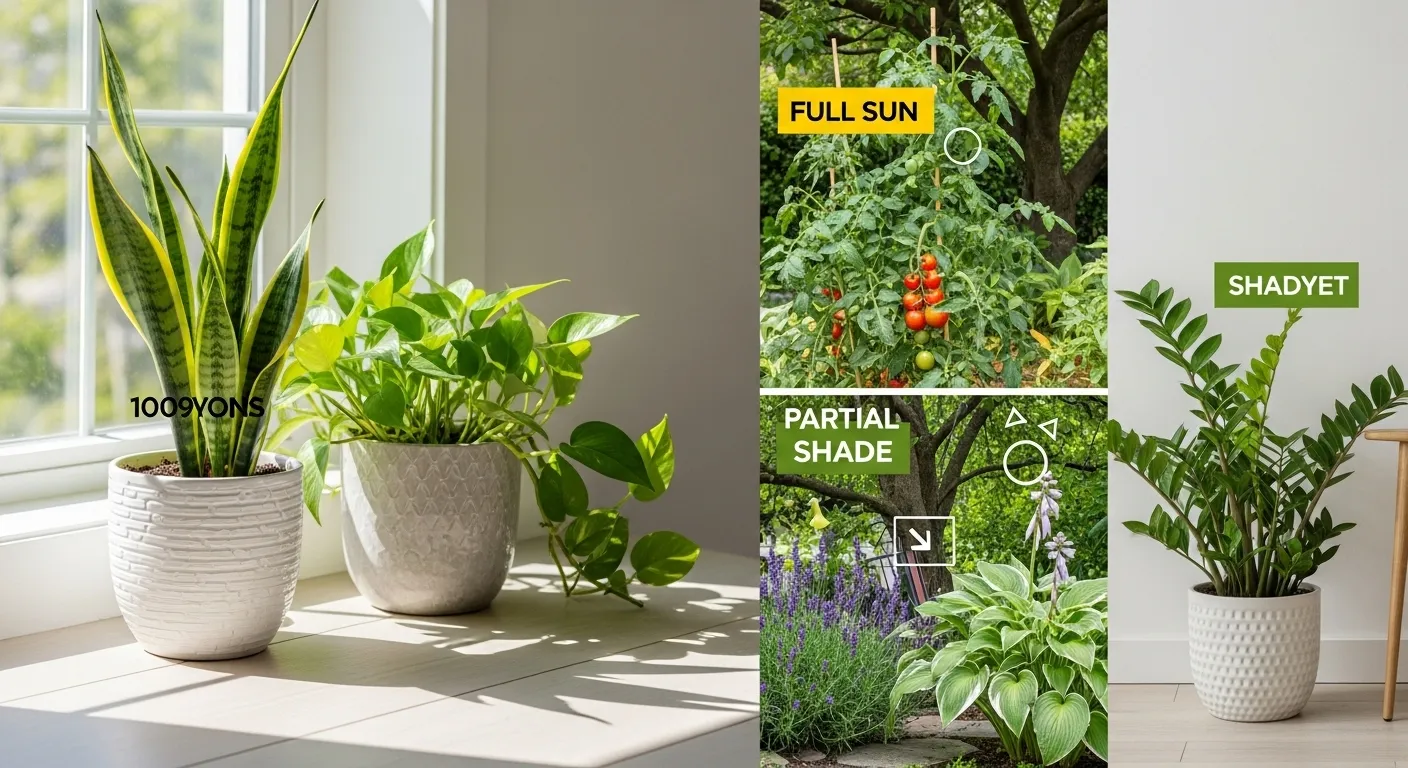
1. Snake Plant (Dracaena trifasciata)
Light minimum: 50 foot-candles Water: Every 2–6 weeks, soil must dry completely Size: 2–5 feet indoors Pet safe: No — toxic to cats and dogs
The most forgiving plant on this list. Snake plants store water in their leaves, which means they handle drought and neglect far better than almost anything else. Their upright, architectural leaves fit tight corners without spreading.
In low light, growth slows considerably — sometimes no new leaves for months. That’s normal. The plant is alive, just dormant-adjacent.
Fails if: Overwatered. Root rot is the only real way to kill one.
2. ZZ Plant (Zamioculcas zamiifolia)
Light minimum: 75 foot-candles Water: Every 3–4 weeks; let soil dry completely Size: 2–4 feet Pet safe: No — toxic if ingested
ZZ plants store water in underground rhizomes, making them almost drought-proof. Their glossy, dark green leaves stay attractive in genuinely dim rooms. This is one of the few plants that performs in windowless offices with only fluorescent lighting.
Fails if: Overwatered or kept in standing water. Root rot develops fast.
3. Pothos (Epipremnum aureum)
Light minimum: 50 foot-candles Water: When top 2 inches of soil dry out Size: Trails 6–10 feet Pet safe: No — toxic to cats and dogs
Pothos is the gold standard for low-light beginners. It signals stress clearly — leaves pale when it wants more light, yellow when overwatered. Stick with solid green varieties (Golden Pothos) in dark rooms. Variegated types like Marble Queen need considerably more light to maintain their patterns because the white portions contain no chlorophyll and can’t photosynthesize.
Trailing from shelves or climbing a totem, pothos works in hallways, bathrooms, and corners 6 to 8 feet from a window.
Fails if: Left in waterlogged soil or placed in a spot with literally zero natural light.
4. Heartleaf Philodendron (Philodendron hederaceum)
Light minimum: 75 foot-candles Water: When top inch of soil is dry Size: Trails 3–6 feet Pet safe: No — toxic
Similar trailing habit to pothos but with a slightly velvety texture. The straight species and ‘Micans’ variety handle low light well. Avoid variegated types like ‘Brasil’ and ‘Silver Stripe’ in dark spots — they need more light than the darker rooms can offer.
Fails if: Overwatered. The roots are prone to rot when kept wet.
5. Peace Lily (Spathiphyllum)
Light minimum: 75–100 foot-candles Water: When it droops slightly — it signals thirst clearly Size: 1–4 feet Pet safe: No — toxic to cats and dogs
The only plant on this list that flowers in low light. Blooms less frequently in dim conditions but still produces its white spathes. Peace lilies also remove formaldehyde, benzene, and carbon monoxide from indoor air — documented in NASA’s 1989 Clean Air Study, though don’t expect dramatic air purification from one plant.
Fails if: Placed in direct sunlight (leaves burn) or overwatered.
6. Cast Iron Plant (Aspidistra elatior)
Light minimum: 50 foot-candles Water: Every 2–3 weeks; tolerates drought Size: 2–3 feet Pet safe: Yes
The name is accurate. Cast iron plants have survived Victorian parlors lit by gas lamps, modern offices with no windows, and neglect that would kill almost anything else. Native to forest floors in Japan and Taiwan, they’re built for deep shade.
Growth is extremely slow in low light — expect 1 to 2 new leaves per year. New cultivars like ‘Milky Way’ add spotted interest to the dark green foliage.
Fails if: Direct sun — it will scorch. Otherwise almost nothing kills it.
7. Chinese Evergreen (Aglaonema)
Light minimum: 100 foot-candles for green varieties; 150+ for colorful ones Water: When top inch of soil is dry Size: 1–3 feet Pet safe: No — toxic
Aglaonemas offer colorful foliage without needing much light — but there’s a rule. Dark green varieties (like ‘Black Lance’ or ‘Emerald Beauty’) handle genuinely dim rooms. Pink, red, and tricolor varieties need more light to maintain their color and will slowly revert to green in shade.
Fails if: Kept in cold drafts (below 60°F) or overwatered.
8. Dracaena ‘Janet Craig’ (Dracaena deremensis)
Light minimum: 75 foot-candles Water: Every 2–3 weeks; tolerates neglect Size: 2–6 feet Pet safe: No — toxic
The best Dracaena variety for dark rooms. Solid dark green, no variegation — meaning every cell contains chlorophyll and works at full efficiency in dim light. Removes formaldehyde and benzene. Common in offices and commercial buildings for exactly this reason.
Fails if: Fluoride in tap water causes brown leaf tips. Use filtered or distilled water if this happens.
9. Spider Plant (Chlorophytum comosum)
Light minimum: 100 foot-candles Water: When top 2 inches dry out Size: 1–2 feet wide; produces hanging babies Pet safe: Yes
One of the few truly pet-safe options for low-light rooms. Spider plants produce arching leaves and long stems tipped with baby plantlets — easy to propagate by pinning the babies into fresh soil. They handle dim bathrooms well. Keep the solid green variety in darker spots; the striped version needs a bit more light.
For a guide on propagating spider plants and other houseplants, that walkthrough covers soil-based, water, and division methods.
Fails if: Fluoride in tap water — causes brown leaf tips. Switch to rainwater or filtered water.
10. Bird’s Nest Fern (Asplenium nidus)
Light minimum: 100 foot-candles Water: Keep soil consistently moist; don’t let it dry Size: 1–2 feet Pet safe: Yes
Its broad, wavy fronds unfurl from a central rosette. Unlike most ferns, bird’s nest ferns handle lower humidity reasonably well — making them better suited to average homes than Boston ferns. Avoid misting directly into the center crown, which promotes rot.
Fails if: Soil dries out completely, or placed in direct sun.
11. Parlor Palm (Chamaedorea elegans)
Light minimum: 75–100 foot-candles Water: When top inch of soil dries Size: 2–6 feet Pet safe: Yes
Parlor palms have been grown indoors since the Victorian era specifically because they handle shade. Soft, feathery fronds. Slow growing indoors — a 3-foot plant may take several years to reach 5 feet in low light.
Fails if: Overwatering or waterlogged soil — root rot develops quickly.
12. Calathea / Goeppertia
Light minimum: 100–150 foot-candles Water: Keep consistently moist; use filtered water Size: 1–3 feet Pet safe: Yes
Calatheas fold their leaves at night and open them in the morning — a movement called nyctinasty. Their bold patterns (stripes, spots, watercolor-like markings) hold in indirect light. Fussier than most on this list — they dislike fluoride and mineral deposits in tap water and prefer higher humidity.
Fails if: Tap water with high mineral content, dry air, or inconsistent watering.
13. Prayer Plant (Maranta leuconeura)
Light minimum: 100 foot-candles Water: Keep evenly moist; don’t let it dry Size: 6–12 inches Pet safe: Yes
Related to calathea and shares the leaf-folding movement at night. Tricolor leaf patterns — deep green, lighter green, and red veins — stay vibrant in low light. Prefers warm, humid rooms. A good bathroom plant if the bathroom gets a little natural light through a small window.
Fails if: Direct sunlight bleaches the leaf patterns.
14. English Ivy (Hedera helix)
Light minimum: 100 foot-candles Water: When top inch of soil dries Size: Trails or climbs 3–8 feet Pet safe: No — toxic
English and Algerian ivy varieties manage low light better than most. Trailing from a high shelf or trained up a small trellis, ivy adds a classic, collected look to dim rooms. NASA’s Clean Air Study flagged ivy as one of the more effective air-purifying houseplants — removing benzene, formaldehyde, xylene, and toluene.
Fails if: Kept too warm and dry — spider mites thrive in those conditions.
15. Monstera deliciosa
Light minimum: 100–150 foot-candles Water: When top 2 inches dry out Size: 3–8 feet indoors Pet safe: No — toxic
Monsteras prefer bright indirect light but adapt to dimmer rooms reasonably well. In low light, the iconic leaf splits (fenestrations) won’t develop on new leaves — you’ll get whole, unfenestrated leaves instead. The plant stays healthy; it just looks different. If you want the dramatic split-leaf look, this plant needs more light than a truly dark room offers.
Fails if: Overwatering in low light — reduce watering frequency significantly compared to brighter conditions.
16. Peperomia
Light minimum: 75–100 foot-candles Water: Let soil dry completely between waterings Size: 6 inches to 1 foot Pet safe: Yes
Peperomias store water in their thick leaves and tolerate irregular watering well. Hundreds of varieties exist — most handle low light. They were commonly called “radiator plants” because they thrived on interior radiator covers with no nearby windows. Small and compact; ideal for desks, shelves, and bathrooms.
Fails if: Overwatering — their succulent-like leaves make root rot very easy to trigger.
17. Nerve Plant (Fittonia)
Light minimum: 100 foot-candles Water: Keep consistently moist; mist regularly Size: 3–6 inches Pet safe: Yes
Tiny, striking, and dramatic. Nerve plants have intricate red, pink, or white vein patterns on deep green leaves. They’re fussy about humidity and moisture but handle genuinely low light well. Best in terrariums or grouped with other plants where humidity stays higher.
Fails if: Allowed to dry out. It wilts fast and dramatically — though it usually recovers if watered quickly.
18. Dieffenbachia (Dieffenbachia seguine)
Light minimum: 100 foot-candles Water: When top inch of soil dries Size: 3–6 feet Pet safe: No — causes mouth and throat irritation if chewed
Large, tropical leaves with cream and green variegation. Handles low light but grows faster with a little more indirect light. Keep the darker-leaved varieties for truly dim rooms.
Fails if: Direct sunlight scorches leaves; cold drafts below 60°F cause yellowing.
19. Corn Plant (Dracaena fragrans)
Light minimum: 75 foot-candles Water: Every 2–3 weeks; tolerates drought Size: 4–6 feet Pet safe: No — toxic
A tall, architectural plant with a woody stem and long arching leaves. Makes a statement in dim corners where height is needed. Very slow growing in low light, but stays healthy and attractive for years with minimal care.
Fails if: Fluoride in tap water — causes brown leaf tips. Switch to filtered water.
20. Rex Begonia (Begonia rex)
Light minimum: 100–150 foot-candles Water: When top inch dries; avoid crown rot Size: 12–18 inches Pet safe: No — toxic
Grown for its spectacular leaf patterns — metallic silver, burgundy, deep green, and purple combinations. Handles lower light better than most flowering plants. Prefers higher humidity. Don’t mist directly on the leaves — water droplets cause spotting.
Fails if: Overwatering or direct cold drafts.
21. Lucky Bamboo (Dracaena sanderiana)
Light minimum: 75 foot-candles Water: Keep roots submerged (water-grown) or soil moist Size: 1–3 feet Pet safe: No — toxic to cats and dogs
Not actually bamboo — it’s a Dracaena. Grows in water or soil, tolerates low light, and has an unusually long lifespan when its water is changed weekly (for water-grown specimens). Change the water every 7–10 days and add a drop of liquid fertilizer monthly.
Fails if: Chlorinated tap water causes browning. Use filtered or distilled water.
22. Lady Palm (Rhapis excelsa)
Light minimum: 100 foot-candles Water: When top inch dries; prefers some humidity Size: 3–6 feet Pet safe: Yes
Fan-shaped fronds on slender stems. Slow growing but very long-lived — some specimens are kept for decades. One of the best palms for genuinely low-light conditions. Also an effective air purifier, removing ammonia, formaldehyde, and xylene.
Fails if: Direct sun or dry air with no humidity.
23. Boston Fern (Nephrolepis exaltata)
Light minimum: 100 foot-candles Water: Keep evenly moist; mist regularly Size: 1–3 feet Pet safe: Yes
Lush, arching fronds with a classic look. The most demanding plant on this list in terms of humidity — Boston ferns need consistent moisture in the air or their fronds brown at the edges. Bathrooms with low natural light are their ideal environment.
Fails if: Low humidity. In dry rooms, fronds shed constantly.
24. Kentia Palm (Howea forsteriana)
Light minimum: 100 foot-candles Water: When top inch dries; tolerates some drought Size: 5–10 feet indoors Pet safe: Yes
The most elegant palm for indoor use. Kentia palms handle dim rooms, dry indoor air, and occasional neglect far better than most palms. Slow growing indoors — a 6-foot plant will likely stay around that height for years. Popular in hotels and offices for exactly this reason.
Fails if: Waterlogged soil or very cold conditions below 55°F.
25. Rubber Plant — Dark Varieties Only (Ficus elastica)
Light minimum: 100–150 foot-candles Water: When top 2 inches dry out Size: 4–10 feet Pet safe: No — toxic
One important caveat: only the dark-leaved varieties (Ficus elastica ‘Burgundy’, ‘Abidjan’) work in genuinely low-light rooms. Variegated types like ‘Tineke’ and ‘Ruby’ need significantly more light. Dark varieties grow slowly in low light but remain healthy and maintain their deep burgundy or near-black leaf color.
Fails if: Overwatering or cold drafts — the thick leaves hide stress until it’s quite advanced.
How to Care for Plants in Low-Light Conditions
Low-light care isn’t the same as standard indoor plant care. A few adjustments make a real difference.
Water less. Plants in dim rooms photosynthesize slowly, which means they use water slowly. Watering on the same schedule you’d use in a bright room almost guarantees root rot. Always check soil moisture before watering — not by schedule, but by feel. Stick your finger 2 inches into the soil. If it’s still damp, wait.
If you’re unsure about moisture levels, a moisture meter for plants takes the guesswork out entirely — especially useful for plants in dark corners where soil dries unpredictably.
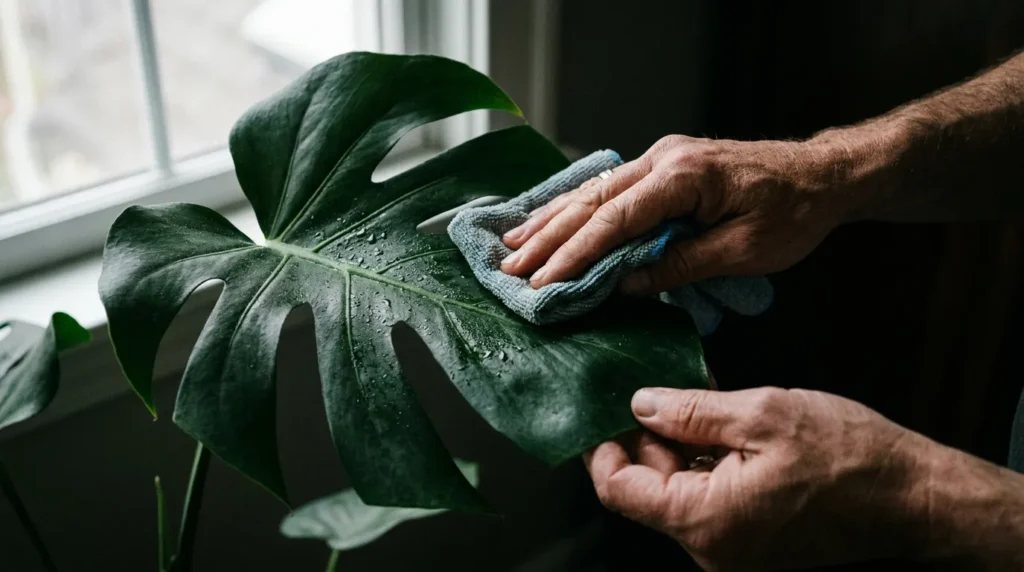
Clean leaves monthly. Dust accumulates on leaf surfaces and blocks light absorption. In a dim room where every photon counts, a layer of dust makes a measurable difference. Wipe leaves with a damp cloth once a month.
Choose solid green over variegated. The white, cream, or yellow sections in variegated plants contain no chlorophyll. Those sections can’t photosynthesize at all — the entire photosynthetic workload falls on the green portions. In low light, this means a variegated plant is effectively working with 30 to 50% fewer functional leaf cells than a solid green variety. Go with solid green in dim rooms.
Rotate 90 degrees monthly. Plants grow toward light. A plant that never rotates develops a lopsided shape over time. A quarter turn once a month ensures all sides receive light and encourages even, balanced growth.
The swap strategy for very dark rooms. Buy two of the same plant. Keep one in a brighter spot (near a window or under a grow light) and one in the dark room. Swap them every 2 to 4 weeks before either shows stress. This lets you display plants in otherwise impossible spots.
For seasonal adjustments — including how to cut back on fertilizing in winter when growth slows — this winter plant care guide for indoor houseplants covers timing and techniques for the colder months.
For a consistent fertilizing schedule built around your specific indoor plants, that guide maps out timing by plant type and season.
Signs Your Plant Isn’t Getting Enough Light
Etiolation (stretching). The distance between each leaf node gets longer and longer. The plant leans hard toward its nearest light source. This is called etiolation — the plant is stretching to find more light. It means the spot is too dark, not that the plant needs more water or fertilizer.
Yellowing leaves, especially lower ones. Yellow leaves at the base are a common sign of insufficient light combined with overwatering. In low light, the plant can’t process water fast enough, so roots stay wet too long.
No new growth for months. Slow growth is normal in low light. Zero growth for more than 3 to 4 months — especially in spring or summer — suggests the plant needs more light.
Faded or washed-out leaf color. Patterned leaves losing contrast, green leaves going pale — both indicate inadequate light. The plant is reducing its pigment production because it can’t use it efficiently.
If you’re noticing early stress symptoms, this checklist on common signs of overwatering plants helps separate light stress from watering issues, which often look similar.
When You Need a Grow Light
Some spaces genuinely need artificial supplementation:
- Windowless offices or interior rooms with zero natural light
- Basements where windows are small, high, or absent
- North-facing rooms in winter where light drops below 50 foot-candles for months
A basic full-spectrum LED grow light running 12 to 14 hours per day can bring even a windowless room into viable plant territory. Place the light 12 to 24 inches above the plant. You don’t need expensive equipment — a simple clip-on or shelf grow light handles most of the plants on this list.
If you’re also interested in growing edibles indoors alongside your foliage plants, this hydroponic gardening guide for beginners covers how to set up a system that works entirely under artificial light.
Pet-Safe Low-Light Plants: Quick Reference
| Plant | Pet Safe? |
|---|---|
| Cast Iron Plant | ✅ Yes |
| Spider Plant | ✅ Yes |
| Parlor Palm | ✅ Yes |
| Calathea / Goeppertia | ✅ Yes |
| Prayer Plant | ✅ Yes |
| Bird’s Nest Fern | ✅ Yes |
| Boston Fern | ✅ Yes |
| Kentia Palm | ✅ Yes |
| Lady Palm | ✅ Yes |
| Peperomia | ✅ Yes |
| Nerve Plant (Fittonia) | ✅ Yes |
| Snake Plant | ❌ Toxic |
| ZZ Plant | ❌ Toxic |
| Pothos | ❌ Toxic |
| Peace Lily | ❌ Toxic |
| Heartleaf Philodendron | ❌ Toxic |
| Monstera | ❌ Toxic |
| English Ivy | ❌ Toxic |
| Rubber Plant | ❌ Toxic |
If pets are in the picture, cast iron plant and parlor palm are your most durable, pet-safe options for genuinely dark rooms.
Air-Purifying Low-Light Plants (What the NASA Study Actually Found)
The 1989 NASA Clean Air Study identified several common houseplants that removed airborne pollutants in controlled chamber conditions. Important context: those were sealed chambers, not open rooms. In a normal ventilated home, you’d need a large number of plants to make measurable air quality changes. That said, the plants still perform some air filtering, and the benefit is real — just modest in practical conditions.
The top performers from this list:
- Peace Lily — removes benzene, formaldehyde, trichloroethylene, ammonia
- English Ivy — removes benzene, formaldehyde, xylene, toluene
- Dracaena ‘Janet Craig’ — removes formaldehyde, benzene, trichloroethylene
- Spider Plant — removes formaldehyde, xylene
- Lady Palm — removes ammonia, formaldehyde, xylene
If you’re choosing for air quality reasons, peace lily and Janet Craig give you the best return in low-light conditions.
Choosing the Right Pot and Soil
Plant containers matter more in low light. Terracotta pots dry out faster — in dim rooms where plants already use water slowly, plastic or glazed ceramic pots extend the time between waterings and reduce overwatering risk.
For choosing container sizes that match your plant’s root system, this guide on picking the right pot size for your plants explains why sizing up too quickly causes problems — especially for slow-growing low-light specimens.
If you’re building out a display and want DIY plant stand ideas under $30, those projects work well for grouping low-light plants at different heights, which also helps them share humidity and create a microclimate.
You can also use the watering schedule generator to build a custom watering plan based on your plant type, pot size, and room conditions — especially useful when managing several low-light plants with different needs.
Conclusion
Most low-light plant failures come down to two things: wrong plant selection and overwatering. The 25 plants above genuinely handle dim conditions — some spectacularly so. The cast iron plant and ZZ plant sit at the top for pure darkness tolerance. Spider plant, parlor palm, and peperomia lead the pet-safe category. Peace lily is the only one that flowers in the dark.
Start with one or two, adjust your watering frequency down from what you’d expect, clean the leaves monthly, and let the plant settle in for 4 to 6 weeks before judging its performance. Most of these plants take a few weeks to acclimate to a new environment before they show their real resilience.
Pick the right plant for the actual conditions you have — not the conditions the label claims they need — and these will last years.

Leave a Reply