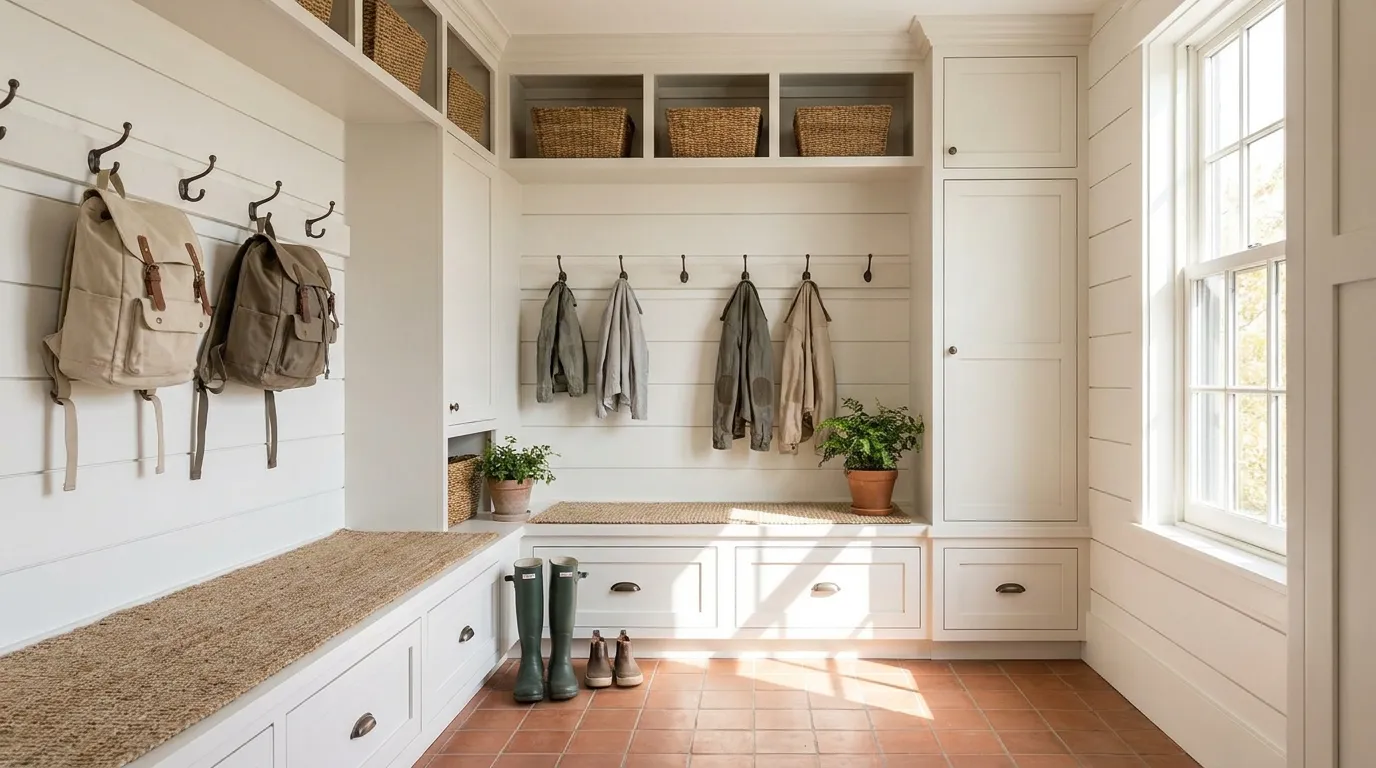
Most mudrooms fail within a week. Not because of bad design — because there was no system behind it. A few hooks on the wall and a shoe rack near the door looks good on day one. By day five, coats are on the floor and shoes are everywhere except the rack.
This article covers 30 specific ideas, organized by category, across every space size and budget. Some of these you can do today for free. Others require a weekend project or custom built-ins. All of them are based on how real families actually enter and exit a home.
Before You Organize: Map Your Entry First
Before you buy a single bin or drill a single hook, stand in your doorway. Watch where people actually go. Most households fall into one of three patterns.
Single-wall entries (narrow hallways, small apartment foyers, side doors) need everything on one wall — hooks, bench, and shelving in a tight linear stack. Depth matters here: a bench at 16–18 inches deep is enough to sit on without blocking foot traffic.
L-shaped entries (small dedicated mudrooms, garage pass-throughs) allow storage on two walls. One wall handles hanging gear; the other handles shoes and benches. This layout creates a natural drop zone in the corner.
U-shaped layouts (full mudrooms, larger laundry combos) wrap storage around three sides and work best for families of four or more. Each wall can serve a different purpose — outerwear, shoes, bags — which reduces the pileup that happens when everyone uses one spot.
Before any renovation or purchase, do a quick declutter pass through your entry zone. Purging what doesn’t belong there clears the picture for what storage you actually need.
Bench Ideas
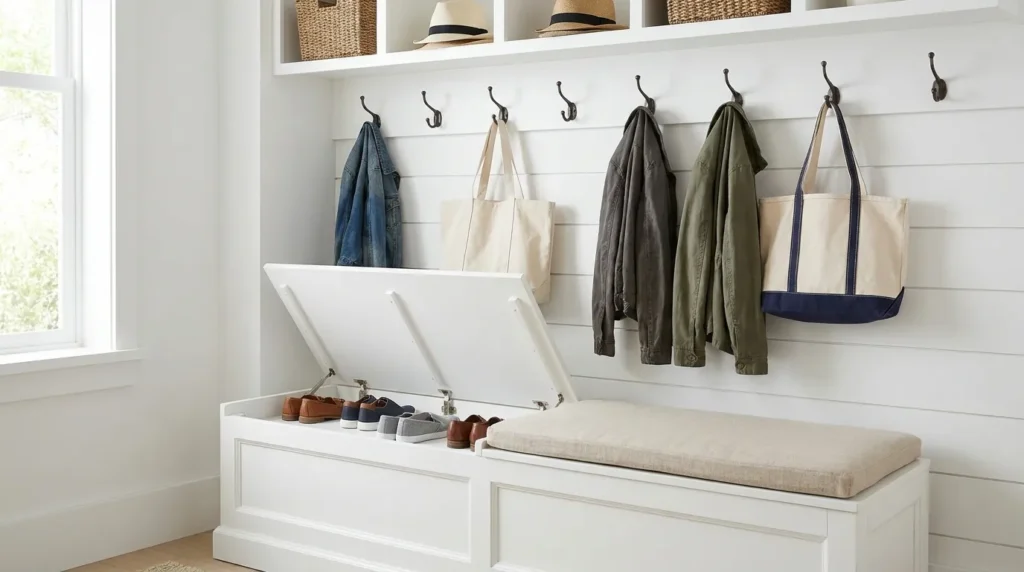
1. Storage Bench with Lift-Top Lid
Cost tier: $80–$250 | All space sizes
A lift-top bench is the single most efficient piece of mudroom furniture you can own. It does three things at once: gives you a place to sit while putting on shoes, hides clutter behind a closed lid, and holds bulkier items that don’t fit on shelves. Hat piles, dog leashes, reusable shopping bags — all gone from view. Choose a bench with a hinged lid and a soft-close mechanism so it doesn’t slam on small fingers.
2. Bench with Pull-Out Boot Drawers
Cost tier: $200–$600 | Medium to large spaces
Boot drawers under a built-in bench are one of the most underused mudroom features. The drawer depth (typically 18–20 inches) fits both adult and kids’ boots without stacking. Add waterproof liners to the drawer base — they catch snow melt, mud, and water and wipe clean in seconds. Dirty boots stay off the floor entirely, which keeps the rest of the space cleaner by default.
3. Floating Bench with Open Cubby Below
Cost tier: $150–$400 | Small to medium spaces
A wall-mounted floating bench clears the floor underneath, which matters in tight entries. The open cubby below becomes natural shoe storage — pairs slide in face-forward and stay visible. Because the bench is wall-hung rather than floor-standing, sweeping and mopping the floor is easy. Standard mounting height is 17–19 inches from the floor, which is comfortable for most adults and older kids.
4. Hall Tree Combo
Cost tier: $100–$350 | Small to medium spaces
A hall tree combines a bench, hooks, upper shelf, and sometimes a mirror into one freestanding unit. It’s the fastest way to add a functional mudroom to a space that has nothing. For renters or anyone who can’t drill into walls, a hall tree requires zero installation. Look for one with at least 5 hooks and a shelf deep enough (10–12 inches) to hold a basket.
Hook Systems
5. Double-Row Hook Rail (Adult + Child Heights)
Cost tier: $30–$80 | All space sizes
One row of hooks at 60–66 inches handles adult coats. A second row at 36–42 inches puts kids’ bags within reach without help. This two-tier system is the single biggest behavioral change you can make for a family mudroom — kids actually use hooks they can reach. Space each hook 8–10 inches apart to prevent coats from bunching and tangling.
6. Individual Assigned Hooks Per Person
Cost tier: $20–$60 | All space sizes
Labeled hooks — one set per person — are more effective than a shared hook rail. When everyone has their own spot, there’s no decision to make at the door. They hang their coat on their hook, and that’s the entire system. Label with chalkboard paint tags, letter stamps, or simple adhesive labels. For a deeper look at time-saving organization systems that actually hold up long-term, assigning ownership to every item is the common thread.
7. Adjustable Peg Rail System
Cost tier: $40–$120 | All space sizes
A Shaker-style peg rail with removable wooden pegs lets you shift hook placement by season or as kids grow. In winter, pegs spread out to fit bulkier coats. In summer, you can tighten the spacing and add small baskets. A standard 48-inch rail typically holds 7–9 pegs. Install the rail at 58–64 inches from the floor for a functional all-household height.
8. Over-the-Door Hook Rack
Cost tier: $15–$45 | Small spaces | Renter-friendly
For renters or anyone who can’t put holes in walls, an over-the-door rack adds 6–12 hooks instantly with zero hardware. Hang it on the inside of a coat closet door or the back of the entry door itself. These work best for lightweight items — scarves, hats, lightweight bags, umbrella. For heavier coats, you need wall-mounted hooks rated for 10–15 lbs per hook. You can also install no-drill wall shelves nearby to extend the system.
Shoe Storage
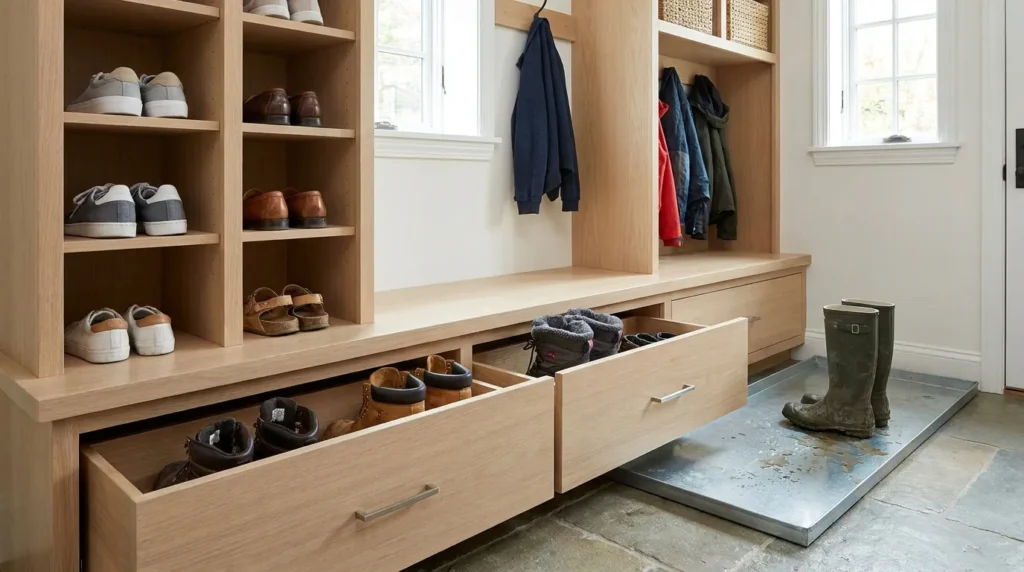
9. Under-Bench Boot Drawers with Waterproof Liners
Cost tier: Custom / $300+ built-in
Already covered this above in the bench section, but it deserves its own mention: waterproof drawer liners are non-negotiable if you live anywhere with snow, rain, or mud. Standard liner options are heavy-gauge rubber or EVA foam. Cut them to fit, and the drawer becomes fully self-contained. No more water rings on hardwood floors.
10. Vertical Shoe Tower
Cost tier: $50–$150 | Small to medium spaces
A narrow vertical shoe tower (typically 10–12 inches wide) fits between cabinets or in a corner and stores 12–20 pairs depending on height. Built-in dividers let shoes dry naturally in individual slots — much more effective than stacking. This works especially well for households that rotate between 3–4 pairs of everyday shoes per person.
11. Open Shoe Cubbies Per Person
Cost tier: $60–$200 | Medium to large spaces
One cubby per person eliminates the communal shoe pile. Each person owns their square, and anything outside of it is theirs to deal with. Standard cubby dimensions of 12 x 12 x 12 inches fit most adult shoes lying flat. For boots, you need a taller opening — 14–16 inches minimum. Open cubbies are easier for kids to use than drawers and faster to maintain than shelves.
12. Boot Tray + Drip Mat System
Cost tier: $15–$40 | All space sizes | Renter-friendly
A boot tray is the cheapest and fastest shoe solution you can add today. A tray 18–24 inches wide holds 2–3 pairs of wet boots, catches water and mud, and lifts directly out for cleaning. Pair it with a rubberized drip mat in front for a two-layer system. This combination keeps wet footwear contained without any installation at all.
13. Angled Shoe Shelf
Cost tier: $40–$120 | Small to medium spaces
Standard flat shelves store shoes toe-to-heel, which wastes depth. Angled shoe shelves tilt at 20–25 degrees so shoes rest heel-up, cutting the depth needed per pair by about 30%. A 24-inch-wide angled shelf typically fits 6–8 pairs versus 4–5 on a flat shelf of the same width. Good option when your wall length is limited.
Per-Person Zones
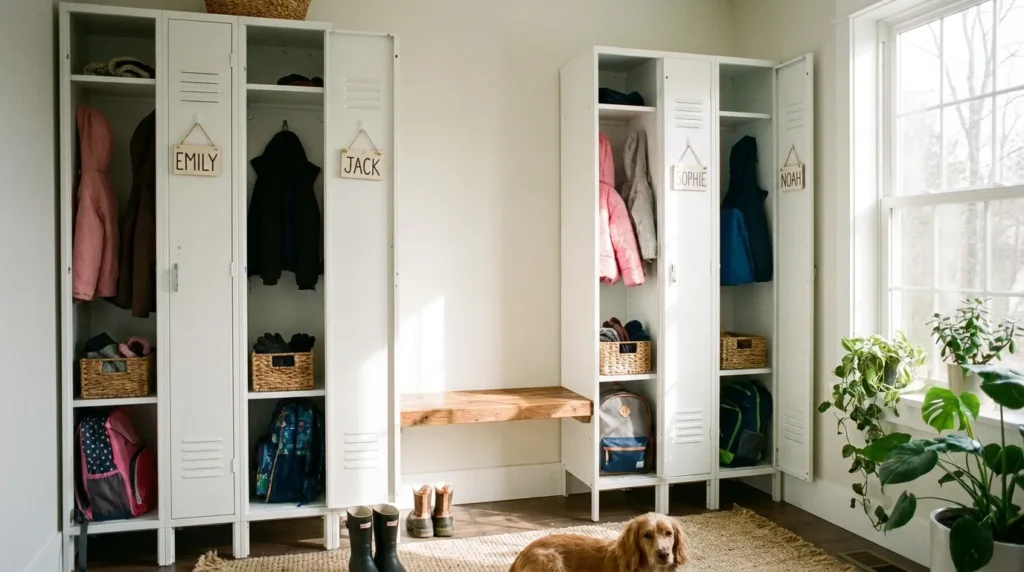
14. Individual Lockers Per Family Member
Cost tier: $400–$1,500 custom | Medium to large spaces
A dedicated locker per person is the most effective long-term system for families with kids. Each locker contains that person’s coat hooks, a basket for small accessories, and space for their backpack. The critical detail: install hooks low enough for kids to manage on their own. If kids can’t reach their hook without help, they won’t use it. Aim for 36–42 inches for elementary-age children.
A seasonal home organization guide can help you think through what each locker holds by season — winter gear in fall, sports gear in spring, sandals and hats in summer.
15. Labeled Baskets Per Person
Cost tier: $30–$80 | All space sizes | Low budget
No room for lockers? Assign each person a labeled basket on an open shelf. Same concept, fraction of the cost. A wicker or fabric basket (12 x 12 inches works for most accessories) holds hats, gloves, chargers, sunglasses — the loose stuff that otherwise piles up everywhere. Label the front clearly. This also makes it obvious who hasn’t put their things away. For more budget-friendly storage container ideas, there’s no shortage of options that look good while staying practical.
16. Color-Coded System for Kids
Cost tier: $20–$60 | All space sizes
Assign each child a color — hooks, baskets, cubby bins, and boot tray all match. Kids who can’t read yet can still find their spot instantly. Color-coded systems require zero labeling and work at ages 2 through 10. Once kids hit middle school, they’ll want to switch to a name-based system. Until then, color is faster and more intuitive. For keeping the toy overflow out of the mudroom and in its own space, toy storage solutions for parents covers the rest of the kid clutter equation.
Vertical Space
17. Floor-to-Ceiling Cabinets
Cost tier: $600–$2,500 custom | Medium to large spaces
Most mudrooms waste 2–3 feet of perfectly usable wall space above eye level. Floor-to-ceiling cabinets with closed doors eliminate visual clutter and double storage capacity compared to open shelving at standard height. Upper cabinets store off-season gear — winter coats in summer, beach bags in winter — so prime storage zones stay clear for daily use. For budget planning on a larger built-in project, the home renovation budget planner can help you set realistic cost expectations before talking to a contractor.
18. Upper Shelves for Seasonal Gear Rotation
Cost tier: $30–$100 | All space sizes
If floor-to-ceiling cabinets aren’t in the budget, open upper shelves accomplish the same seasonal rotation principle. Install a shelf at 72–78 inches (above coat-hook height) and dedicate it entirely to off-season items. Labeled bins with lids keep the shelf looking clean and protect gear from dust. Rotate twice a year — fall/winter swap and spring/summer swap.
19. Pegboard Wall Organizer
Cost tier: $40–$100 | Small to medium spaces | DIY-friendly
A pegboard panel (typically 24 x 48 inches) mounted above a bench gives you fully adjustable storage. Hooks, shelves, baskets, and key holders can all be repositioned without tools. It’s particularly good for households where storage needs change — growing kids, seasonal sports gear, shifting routines. Paint the pegboard to match the wall and it looks built-in rather than temporary.
Small Space and No-Mudroom Solutions
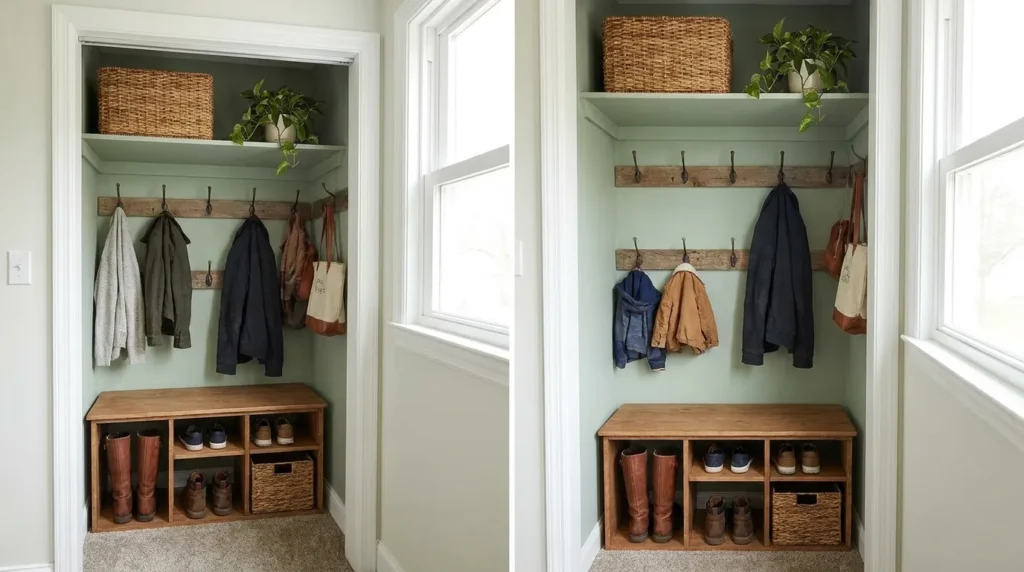
20. Coat Closet Conversion
Cost tier: $100–$400 | Small spaces
Remove the closet doors. That one move opens the space visually and makes everything inside accessible. Paint the interior a different color from the hallway — it frames the space and makes it feel intentional. Add a double row of hooks on the back wall, a small bench or cubby unit on the floor, and one shelf above. You now have a functional mudroom in a space that was previously a closet. For more ideas on maximizing tight closet spaces, closet organization ideas for small spaces covers the full range of conversion approaches.
21. Entryway Nook with Console Table
Cost tier: $80–$250 | Small spaces | Renter-friendly
A narrow console table (10–12 inches deep) paired with wall hooks above and baskets on the shelf below creates a functional mudroom footprint in about 24 inches of wall space. This is the fastest freestanding setup for renters. The table surface becomes a landing spot for keys, mail, and daily essentials. The baskets below handle shoes. The hooks above handle coats. For more entryway organization tips that work without major changes, this combination is consistently the most practical starting point.
22. Garage Entry Drop Zone
Cost tier: $150–$500 | All space sizes
The garage-to-house door is where most daily dirt enters. A dedicated drop zone here — even a simple shelf unit with hooks and a boot tray — stops mud and mess before it reaches the living areas. If your garage is also your storage hub, garage storage systems that actually work can help you design both spaces in a way that doesn’t turn one into overflow for the other.
23. Over-the-Door Organizer
Cost tier: $15–$50 | All space sizes | Renter-friendly
The back of any door near the entry is usable real estate. An over-the-door organizer with adjustable baskets stores shoes, accessories, cleaning supplies, pet supplies, and more. No tools, no wall damage. In a small apartment or rental where wall space is limited, this is one of the better hidden storage ideas for small homes because it uses vertical space that would otherwise sit empty.
Laundry Room Mudroom Combos
24. Shared Hook Wall + Hamper System
Cost tier: $80–$250 | Medium to large spaces
When your mudroom and laundry room share a wall, combine them intentionally. Install coat hooks on the same wall as the washer — coats come off here, laundry goes in here, and the workflow stays in one zone. Add a built-in hamper with removable canvas bins pre-sorted into lights, darks, and towels. If the mudroom-laundry space already handles both dirty clothes and outerwear, choosing eco-friendly laundry detergents that store cleanly in a closed cabinet keeps the combo space feeling less cluttered.
25. Laundry Supply Cabinet with Coat Storage Overflow
Cost tier: $200–$600 | Medium to large spaces
A pantry-style cabinet with doors tucked into the laundry-mudroom area solves two storage problems at once. Upper shelves hold detergent, fabric softener, and cleaning supplies — organized by category. Lower sections serve as overflow coat and bag storage when the main mudroom hooks are full. Closed doors keep both sides invisible from the entry.
Specialty Add-Ons
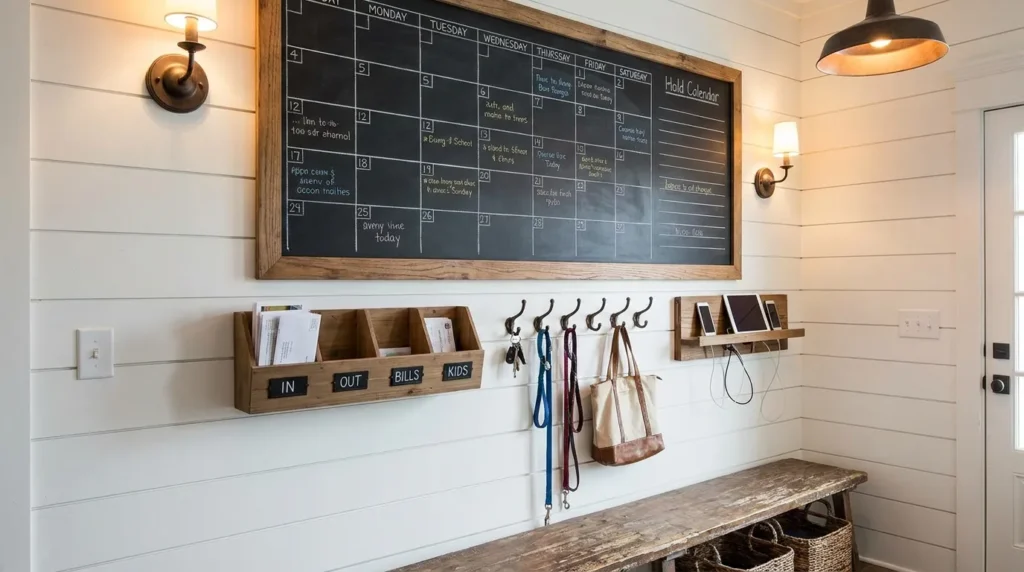
26. Command Center (Calendar, Mail, Key Hook)
Cost tier: $30–$150 | All space sizes
A message board, mail sorter, and key hook in the mudroom sounds simple. The impact is significant. School notices, permission slips, and bills that would otherwise scatter through the house land in one slot. Keys have a home. The calendar is visible every time you leave. The mudroom becomes the operational hub of the house rather than just a coat room. Keep it small — a 12 x 18 inch board plus two wall-mounted mail slots is enough.
27. Pet Station
Cost tier: $40–$150 | All space sizes
Dedicate a small zone to pet supplies: a hook for leashes, a sealed bin for treats and supplies, a wipe-down mat for paws, and a spot for the dog’s towel. After wet walks, everything you need is right at the door before the dog gets further into the house. If pet odors become an issue on the coats and bags hanging nearby, how to remove pet odors from furniture and fabrics covers the full cleaning process.
28. Mudroom Utility Sink
Cost tier: $800–$2,500 installed | Large spaces or new builds
A utility sink in the mudroom is genuinely useful for households that garden, do outdoor sports, or have kids who come home muddy. Boots rinse here. Garden tools clean here. Hands wash before anyone touches the kitchen. The practical prerequisite is proximity to plumbing — if the mudroom is near a laundry room or bathroom, adding a sink line is relatively straightforward. If it requires running new supply and drain lines across the house, the cost climbs fast.
29. Charging Drawer for Devices
Cost tier: $80–$200 | All space sizes
A single drawer near the entry with built-in USB and outlet access solves the scattered charger problem permanently. Phones, tablets, and earbuds go in the drawer when people walk in. They charge while the family is home. They’re at the door when it’s time to leave. A power strip mounted inside the drawer with a cable pass-through at the back keeps the surface clean. This works especially well in families where devices are a constant morning scramble.
Materials That Survive a High-Traffic Entry
Paint choice matters more in a mudroom than almost anywhere else in the house. Standard flat paint shows every scuff and wipe mark within weeks. A satin or eggshell finish in a mudroom holds up to cleaning without losing its finish. Satin is slightly more scrub-resistant; eggshell gives a softer look. Either is a better choice than flat or matte.
For flooring, tile and brick are the most practical options — they’re waterproof, easy to clean, and won’t warp from wet boots. If you want to estimate materials before committing to a tile project, the flooring calculator can help you figure out how much you’ll need based on your space dimensions. Rubber-backed area rugs over existing hardwood work as a mid-budget solution but need a non-slip pad underneath and regular washing.
Hook hardware load ratings are printed on most packages but rarely read. A standard wall hook rated for 5 lbs will not hold a wet winter coat, a backpack, and a lunch bag. Look for hooks rated at 10–15 lbs minimum per hook, especially in kids’ zones where multiple items pile on at once.
30. The Seasonal Rotation System
This is the idea that keeps everything else working.
Every mudroom fills up again. It’s not a failure of organization — it’s just how households work. The fix is a scheduled rotation twice a year, timed with the season change.
In late September or early October: winter coats move to the front hooks, boot drawers get cleared of sandals and filled with snow boots, upper shelves swap beach gear for ski helmets and heavy gloves.
In late March or April: reverse it. Off-season gear goes into labeled bins on upper shelves or in a hall closet. Daily storage clears out for lighter layers and everyday shoes.
This rotation takes about 30 minutes per household. It’s the difference between a mudroom that slowly fills with everything and one that stays functional year-round. Pair it with a broader seasonal home organization strategy and the process becomes automatic rather than reactive.
Wrapping Up
A mudroom works when it’s designed around how your family actually moves — not how a magazine layout looks. Start with your layout and traffic pattern. Pick two or three ideas from this list that solve your biggest daily problems. Build from there.
The bench, the per-person hooks, and the shoe containment system are the foundation. Everything else — command centers, pet stations, charging drawers — layers on top once the basics are solid. Get the basics right first, and the rest of the space takes care of itself.



Leave a Reply