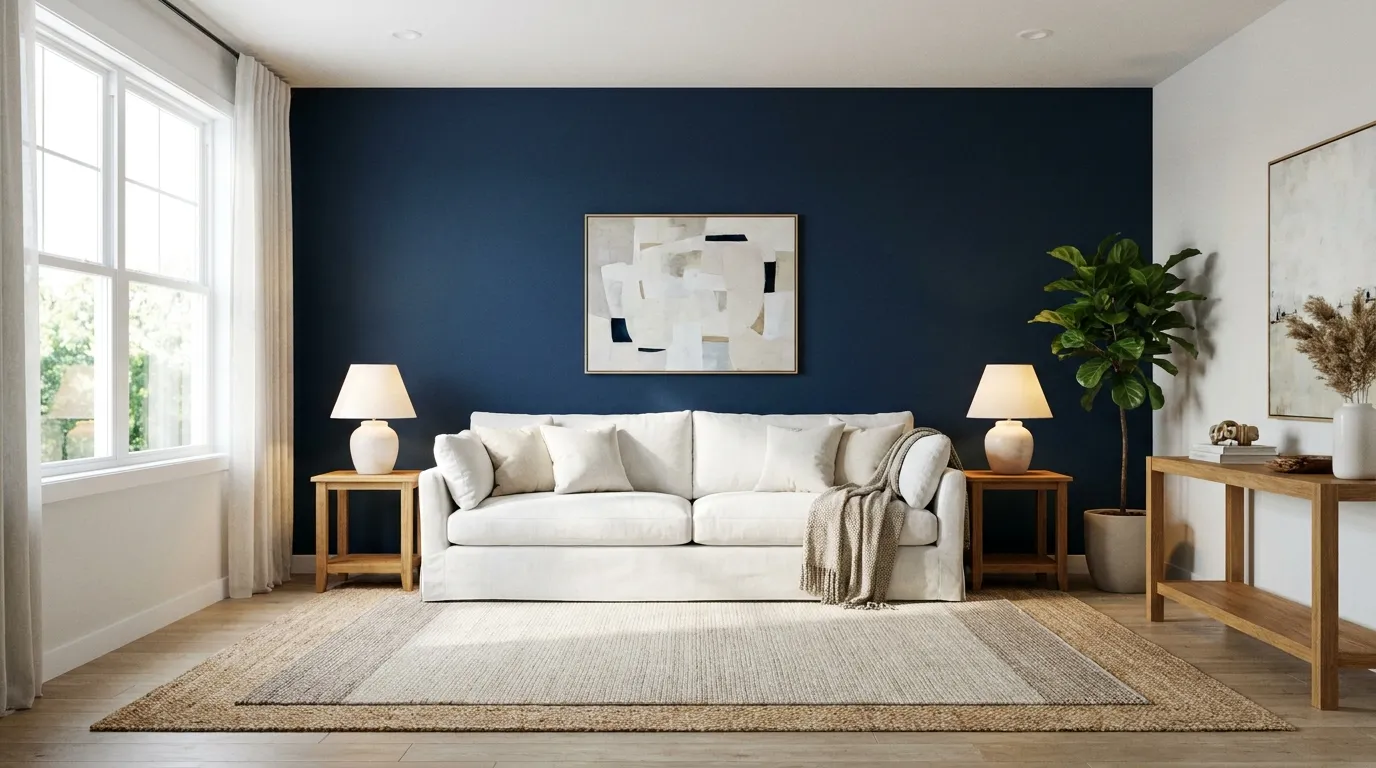
One wall. That’s all it takes to make a room look completely different.
An accent wall is the fastest way to add visual weight, define a space, and give a room personality — without a full renovation. You’re not repainting everything. You’re not buying new furniture. You’re committing to one surface and letting it do the work.
This guide covers 25+ ideas organized by type, room, and budget. Whether you rent or own, whether you have $30 or $500, there’s something here you can act on this weekend.
How to Choose the Right Wall First
Before picking a color or material, pick the right wall. This is where most people go wrong.
The rule is simple: choose the first wall your eye lands on when entering the room.
In a bedroom, that’s almost always the wall behind the headboard. In a living room, it’s typically the fireplace wall, the TV wall, or the one directly opposite the entrance. In a dining room, it’s usually the wall a seated guest faces.
The Focal Point Rule
An accent wall should reinforce an existing focal point — not create confusion. If you have a fireplace, that wall is your anchor. If you have a large window, the opposite wall catches the most reflected light and benefits most from a bold treatment.
Walls to Avoid
Skip walls with too many interruptions. A wall with three windows and two doorways will fight your design, not support it. The accent wall should have enough unbroken surface to read as intentional.
Also avoid making a long, narrow room feel like a tunnel. In hallways, vertical stripes or a light feature wall at the far end can pull the eye forward instead of closing the space in.
Paint Accent Wall Ideas
Paint is the cheapest and fastest option. A single gallon covers roughly 350–400 square feet. For most bedroom or living room accent walls, you’ll use less than a gallon.
Before you start, use a paint coverage calculator to get an accurate estimate so you don’t over-buy.
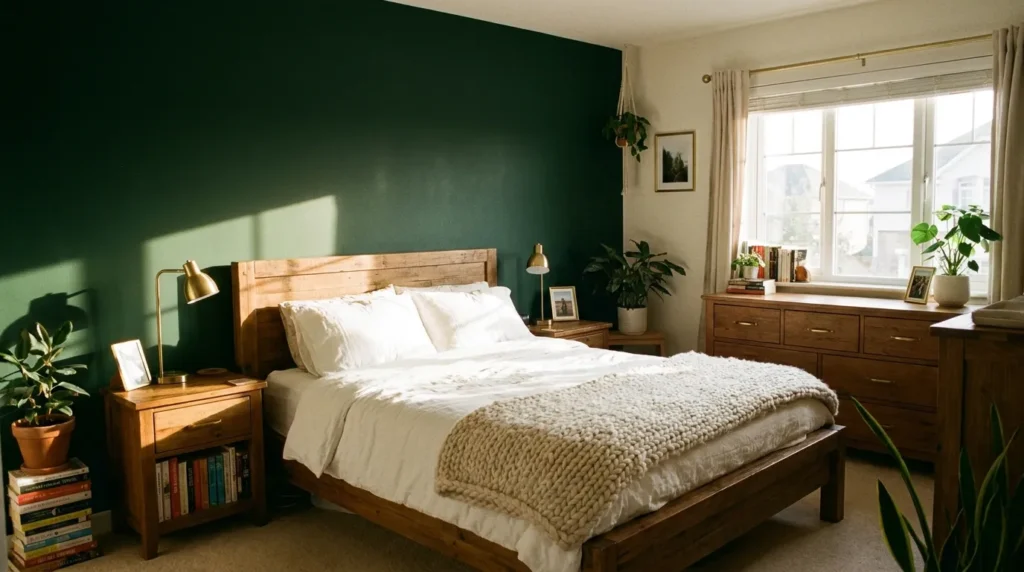
1. Bold Dark Paint Deep colors — navy, charcoal, forest green, slate black — make the biggest impact per dollar spent. They add depth, make art pop, and work in nearly every room. Use a matte or eggshell finish to avoid glare. Farrow & Ball’s Hague Blue, Sherwin-Williams’ Tricorn Black, and Benjamin Moore’s Hale Navy are three of the most consistent performers across bedroom and living room applications. Understanding how color affects mood before you commit is worth the time — the color psychology guide for home interiors breaks this down clearly.
2. Jewel Tones Emerald green, sapphire blue, burnt orange, and deep plum hit differently than standard darks. They carry warmth and saturation that flat neutrals can’t replicate. Best for dining rooms and bedrooms where you want intimacy.
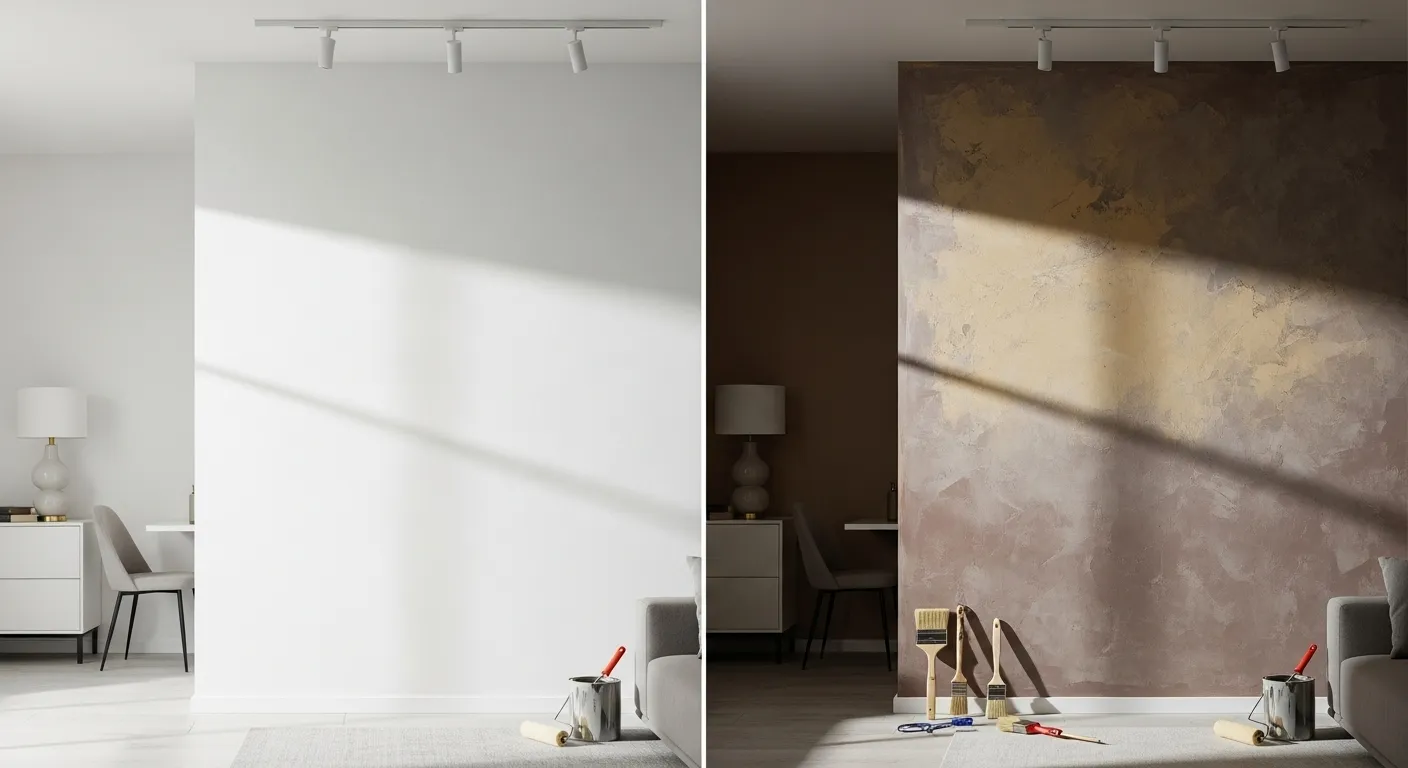
3. Limewash and Plaster Finishes This is the biggest trend in 2025. Limewash creates a layered, chalky, slightly uneven look that photographs beautifully and feels organic rather than painted. It’s applied in overlapping strokes, so each wall looks slightly different. Not a beginner project — but many painting contractors now offer it as a standard service for $3–$6 per square foot.
4. Ombre and Gradient Walls Blend two or three shades of the same color from dark at the bottom to light at the top. Done correctly with a dry brush technique, it reads as a single intentional color rather than a gradual fade. This works particularly well in bedrooms and creates a sense of vertical height.
5. Color-Block Walls Paint half the wall one color, half another. A horizontal divide 54 inches from the floor is a common choice — it aligns with chair rail height and feels architectural rather than arbitrary. Two complementary neutrals work just as well as two contrasting colors.
6. Striped Walls Vertical stripes add height. Horizontal stripes add width. For a hallway or stairwell that feels cramped, thin vertical stripes in two tones of the same color (satin over matte, same base color) give depth without being loud. When selecting your paint sheen, the paint finish guide will help you choose the right one for each room’s conditions.
Wood and Texture Accent Wall Ideas
Texture changes how a room feels, not just how it looks. These options take longer than paint but last for years and add genuine architectural value.
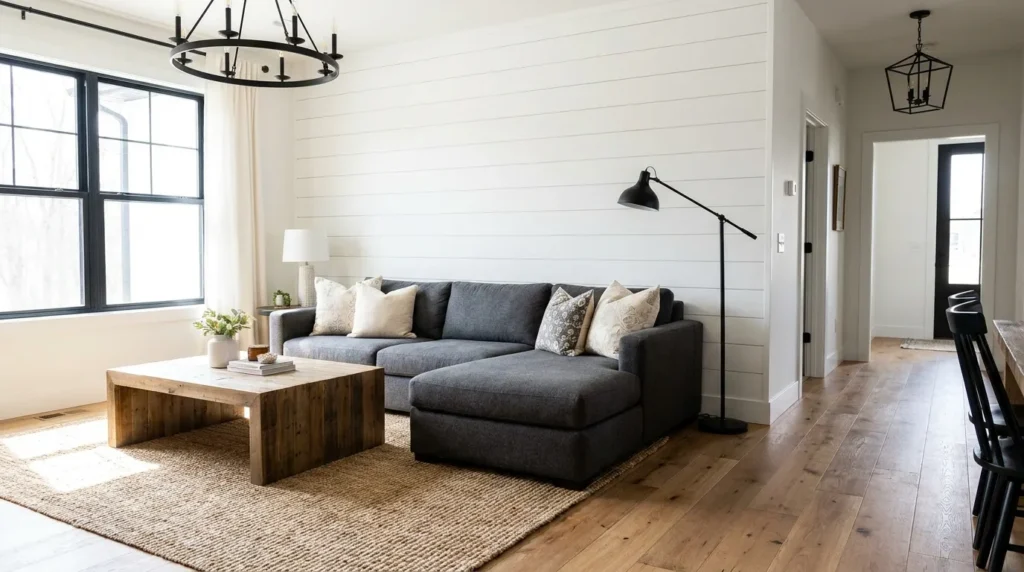
7. Shiplap Shiplap boards run horizontally and overlap slightly. They’re most at home in farmhouse, coastal, and cottagecore interiors but work in modern spaces when painted in a single solid color. An 8×10-foot accent wall takes about 6–8 hours for a first-timer. For more farmhouse-style ideas that pair well with shiplap, the rustic farmhouse DIY decor guide has budget-friendly combinations worth looking at.
8. Board-and-Batten Vertical flat boards (the “batten”) are fixed at regular intervals over a base panel. The result is a clean, structured grid that looks like custom millwork. It pairs well with bold colors — dark green board-and-batten in a home office reads as built-in without the cost. Materials for a standard 8×10 wall run $80–$140.
9. Reclaimed Wood and Wood Slats Individual planks or thin slats installed vertically or horizontally on a wall add warmth that paint simply can’t. Reclaimed wood has grain variation and imperfection that reads as authentic. Modern wood slat panels — typically 1-inch-wide strips with gaps in between — give a Scandinavian feel when stained light and a dramatic look when stained dark. Working with reclaimed wood has its own set of techniques, covered in the reclaimed wood projects guide, which includes prep and finishing tips.
10. Faux Brick Real brick is expensive and heavy. Faux brick panels or peel-on brick veneer tiles (like Z-Brick or similar products) deliver the same industrial look for $1–$3 per square foot. Best in kitchens, basements, home bars, and entryways. Seal after installation with a matte polyurethane to prevent chalking.
11. Stone Veneer Stone veneer panels are 1–2 inches thick and attach directly to drywall with construction adhesive. They look identical to real stone at a fraction of the weight and cost. Natural stacked stone runs $10–$20 per square foot installed. Best for fireplace surrounds, entryways, and outdoor-adjacent spaces.
12. 3D Panels Sculptural wall panels — made from MDF, PVC, or even gypsum — create geometric surface patterns that cast shadows throughout the day as light changes. They’re available in wavy, chevron, hexagonal, and abstract forms. A 100-square-foot wall typically costs $200–$400 in materials. The textured wall painting techniques guide covers how to prep and finish surfaces before panel installation.
Wallpaper and Pattern Accent Wall Ideas
Wallpaper has made a full comeback. The new generation of products is easier to install, more durable, and far easier to remove than the vinyl sheets from decades ago.
If you’re papering a single accent wall, use a wallpaper calculator before ordering — pattern repeat can significantly increase how many rolls you need.
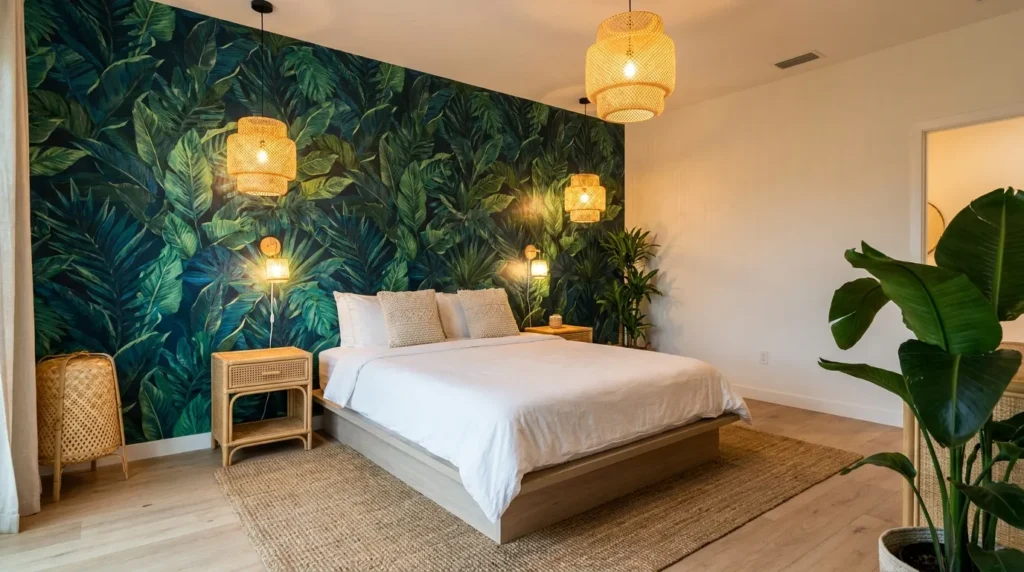
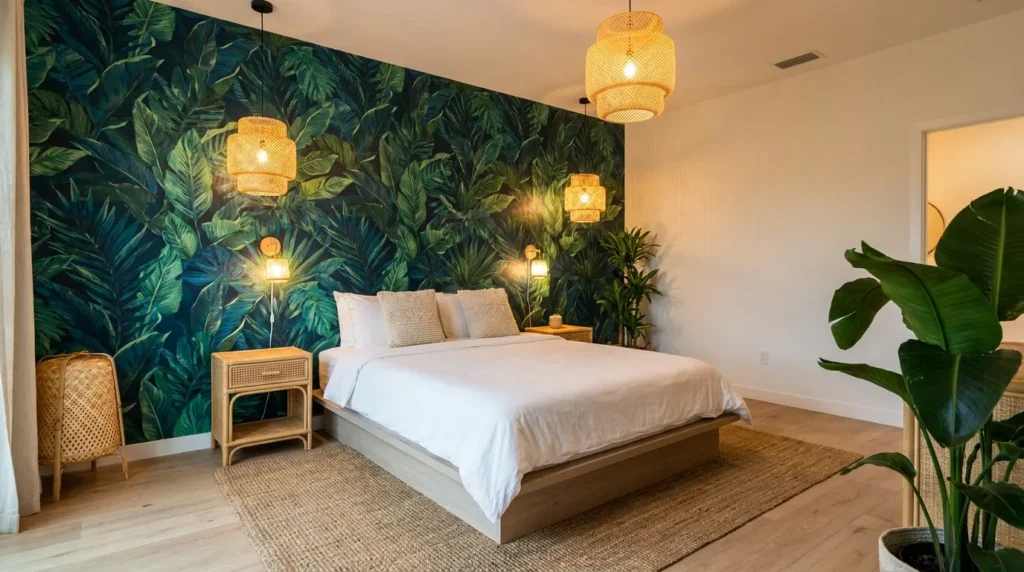
13. Bold Printed Wallpaper Oversized florals, geometric repeats, abstract art prints, or pictorial murals — a single wallpapered accent wall makes a strong statement. You’re typically looking at 4–6 rolls for a standard bedroom or living room wall, at $30–$80 per roll depending on quality. The DIY wallpaper guide for beginners covers cutting, matching, and avoiding bubbles.
14. Peel-and-Stick Wallpaper Renter-safe, repositionable, and increasingly realistic in texture and print quality. Brands like Tempaper, RoomMates, and Chasing Paper offer patterns ranging from subtle linen textures to full botanical murals. Most products last 2–5 years before adhesive degrades. A standard bedroom wall costs $60–$150 in materials.
15. Geometric Stencil A stencil and two colors of paint produce a repeating pattern for under $30 in materials. Popular choices include Moroccan tiles, diamond lattice, and herringbone. The key is a dense foam roller and minimal paint per pass — this prevents bleed. Full instructions for stencil technique are in the DIY stencil wall art guide.
16. Hand-Painted or Decal Murals A full-wall mural — either hand-painted by a local muralist ($300–$1,200 depending on size and complexity) or applied as a peel-and-stick panel set ($100–$250) — turns a wall into a piece of art. Best in entryways, nurseries, and dining rooms where a single wall carries the visual weight of the entire space.
17. Grasscloth and Natural Fiber Wallpaper Woven sisal, jute, or seagrass wallpaper brings texture and warmth without pattern. It reads quiet from a distance but has visible depth up close. Ideal for offices, bedrooms, and spaces that need interest without bold color. Note: grasscloth is NOT renter-friendly — it’s difficult to remove cleanly.
Specialty and Niche Accent Wall Ideas
18. Gallery Wall Group 8–15 frames of mixed sizes on a single wall to create a curated, personal display. The trick is to lay out the arrangement on the floor first, keep consistent spacing (3–4 inches between frames), and anchor the arrangement around one large central piece. The simple DIY wall art projects guide covers how to hang frames without damage and create professional-looking layouts. For a no-drill option, explore DIY wall shelves without drilling for renter-compatible display solutions.
19. Mirror Panels Mirrored panels — either individual tiles or a single large format — double the perceived light in a room and make any space feel larger. Best in small bedrooms, narrow hallways, and bathrooms. Standard 24×48-inch panels run $30–$80 each.
20. Tile Accent Wall Tile works best in kitchens and bathrooms but has moved into dining rooms and living rooms as a design-forward choice. Subway tile, zellige, and large-format marble-look porcelain are the most common choices. For a bathroom or kitchen tile accent wall, use the tile quantity estimator to calculate materials before purchasing.
21. Fabric Panels and Tapestries Upholstered panels (fabric stretched over a wooden frame) add softness and acoustic dampening to a room. In a home office or bedroom, a fabric panel accent wall reduces echo and adds warmth simultaneously. Tapestries work similarly for bohemian and eclectic spaces — easy to install, easy to swap, and genuinely renter-safe.
Accent Walls by Room
Bedroom: Target the headboard wall. Keep the color or material at or below the height of the headboard if you want a cozy, enclosed feel. Go full ceiling height for drama.
Living Room: Fireplace walls are the default choice — they’re already a focal point. The TV wall is the second option if your living room lacks a fireplace. Avoid the wall with your main window; competing with natural light rarely works.
Dining Room: A rich, dark color on the wall guests face when seated makes every meal feel slightly more considered. Forest green, burgundy, and warm terracotta are consistently strong choices here.
Bathroom: Tile is the obvious and practical choice. Even a single wall of patterned tile behind the vanity or inside the shower niche elevates the entire room.
Entryway: This is the most underused room for accent walls. A bold color or patterned wallpaper in a small entryway makes an outsized impression — it’s the first and last thing visitors see. For organizing the entryway alongside the visual upgrade, the entryway organization tips guide pairs well with a fresh wall treatment.
Home Office: Darker colors reduce eye strain and visual distraction. A muted navy or warm charcoal behind your desk reads well on video calls and makes the space feel distinct from the rest of your home.
Budget Breakdown: What Each Option Actually Costs
Under $50: Paint (single wall, 1 gallon): $25–$40. Peel-and-stick wallpaper (small wall): $30–$50. Geometric stencil kit + paint: $25–$35.
$50–$200: Peel-and-stick wallpaper (standard bedroom wall): $60–$150. Shiplap lumber and nails (DIY): $80–$140. Board-and-batten materials: $80–$140. Printed wallpaper (4–5 rolls): $120–$200.
$200–$600+: Stone veneer panels (materials only): $150–$300. 3D MDF panels (materials + adhesive): $200–$400. Tile accent wall (materials only): $200–$500 depending on tile choice. Professional limewash finish: $3–$6 per square foot, so $270–$540 for an average 90 sq ft wall.
For larger renovations involving multiple elements, the home renovation budget planner helps you track and allocate costs across the full project.
2025 Accent Wall Trends Worth Knowing
Limewash and clay paint are the dominant paint trend. The look is raw, layered, and slightly imperfect — which is exactly the point.
Arched panel treatments — either painted arches or applied molding in an arched shape — are showing up in dining rooms and bedrooms at a high rate. You can create this effect with flexible molding strips and a jigsaw.
Fluted and reeded panels are replacing standard board-and-batten as the texture of choice in contemporary interiors. The vertical ridges catch light differently than flat surfaces and feel more custom.
Warm earth tones — terracotta, clay, warm sand, dusty rose — continue to displace the cool grays that dominated the previous decade. They read better in natural and artificial light.
Renter-Safe Accent Wall Ideas
If you can’t paint or make permanent changes, you still have real options:
Peel-and-stick wallpaper remains the best renter solution. Brands have improved significantly — current products come off cleanly on smooth drywall without damage when removed properly (slow, warm-water-dampened corners).
Removable fabric panels (hung from a slim curtain track) cover an entire wall and can be taken down in minutes.
Tapestries and large-scale textile art are genuinely zero-damage. Command hooks hold up to 7.5 pounds per hook — enough for most fabric pieces.
Peel-and-stick tile on a bathroom or kitchen backsplash wall can look identical to real tile and comes off without residue on smooth surfaces.
For more ideas that work in rental spaces, the studio apartment space-saving guide includes wall treatment ideas specifically designed for renters.
5 Common Accent Wall Mistakes to Avoid
1. Choosing the wrong wall. A wall covered in outlets, switches, doors, and windows can’t read as a feature wall. It looks like an accident, not a decision.
2. Going too light in a light room. If all four walls are white and you paint one wall a slightly different shade of white, the effect is invisible. Accent walls need actual contrast to work.
3. Stopping at the wrong height. Carry your accent treatment all the way to the ceiling unless you have a specific architectural reason not to. Stopping at an arbitrary point mid-wall looks unfinished.
4. Skipping proper wall prep. Cracks, holes, and rough patches show through paint and wallpaper. Patching correctly before you start is non-negotiable — the guide to repairing drywall holes quickly covers the right technique for different damage types.
5. Using two accent walls in the same room. Two accent walls almost always compete. One wall gets the focus. Everything else stays neutral. The rare exception is a room with two separate zones — like a dining area and a sitting area in one open space.
FAQ
What color should my accent wall be? Start with the colors already in the room — a rug, a throw pillow, a piece of art. Pull a color that’s present but underrepresented. That creates cohesion. If you’re starting from scratch, dark neutrals (navy, forest green, charcoal) work in almost any room and are hard to regret.
Should the accent wall be lighter or darker than the other walls? Darker in most cases. A darker wall adds depth and makes the room feel more intentional. A lighter accent wall can work when the surrounding walls are very dark, or when you want to open up a small room. But lighter-on-light rarely reads as an accent.
Can you have two accent walls? In a standard room, no — it splits focus and dilutes the effect. In a large open-plan space with two clearly defined zones, two accent walls can work if they’re on non-adjacent walls and different treatments.
How do I know how much paint I need? Measure the wall width and height in feet and multiply. Subtract for any large windows or doors. One gallon covers approximately 350–400 square feet. For a standard 9×12-foot bedroom accent wall (108 sq ft), one quart is usually enough. Use the paint coverage calculator to get an exact number before you shop.

Leave a Reply